
Germany’s Opportunity Card opens legal job-search access for non-IT professionals in healthcare, trades, logistics, construction, and manufacturing—not just tech roles.

Germany’s labour market is undergoing a structural shift. Faced with an ageing population and persistent skill shortages, the country has expanded immigration pathways beyond traditional high-tech roles opening opportunities for non-IT professionals through the Germany Opportunity Card (Chancenkarte).
For many Indian applicants, one major misconception remains: “Germany only hires IT professionals.”In reality, Germany’s current workforce demand spans healthcare, skilled trades, logistics, hospitality, construction, manufacturing, and technical services.
The Opportunity Card, introduced under Germany’s Skilled Immigration Act reforms, allows qualified professionals to enter Germany without a prior job offer and search for employment legally.
However, eligibility is structured, points-based, and often misunderstood.This guide explains who qualifies especially non-IT professionals and how eligibility is actually assessed in 2026.
Key Facts About Germany’s Opportunity Card
The Opportunity Card is a job seeker residence permit designed to attract skilled professionals from non-EU countries.
Unlike traditional work visas, it allows eligible applicants to:
The program shifts Germany’s immigration approach from employer-driven hiring to talent-driven migration.
Germany’s labour shortage is often associated with software engineers and tech specialists, but official labour market data shows a much broader reality. The country’s workforce gap is primarily driven by vocational, service, and technical professions, many of which fall outside the IT sector.
Germany’s economic model relies heavily on skilled vocational training (Ausbildung) and applied professions. As demographic changes reduce the working-age population, industries that depend on hands-on expertise are facing increasing recruitment pressure creating strong opportunities for non-IT professionals through pathways such as the Opportunity Card.
According to Germany’s Federal Employment Agency, shortages exist in more than 160 occupations, with the most critical gaps appearing in healthcare, skilled trades, logistics, construction, and service industries.
At the same time, surveys show that 44% of German businesses report operational difficulties due to lack of skilled staff, highlighting the structural nature of the shortage rather than a temporary hiring cycle.
Germany is experiencing a demographic transition:
Economic studies estimate hundreds of thousands of skilled workers are needed annually, particularly in vocational professions rather than academic roles.
This is one of the main reasons Germany introduced flexible immigration pathways like the Opportunity Card to attract globally trained professionals across multiple sectors, not just technology.
Below are key sectors where foreign professionals including Indian applicants have realistic employment prospects.
Germany has one of Europe’s oldest populations, increasing demand for healthcare and long-term care services.
Key facts:
Opportunity Card relevance:
Healthcare assistants, caregivers, physiotherapy technicians, and medical support staff can enter Germany and search for employment locally especially after language improvement.
Typical roles:
Germany’s economy depends heavily on skilled trades — electricians, mechanics, and technicians who maintain infrastructure and manufacturing systems.
Industry data shows:
High-opportunity roles:
These professions align strongly with Germany’s vocational qualification recognition system making them suitable for Opportunity Card applicants.
Germany faces a national housing shortage estimated at around 1.4 million homes, requiring large-scale construction expansion.
To meet demand, Germany needs continuous workforce inflow in construction-related roles.
In addition:
Opportunity Card opportunities include:
As infrastructure projects expand, skilled foreign workers become essential.
Germany is Europe’s logistics hub, connecting manufacturing, exports, and continental trade networks.
Labour agency data identifies shortages in:
Growth in e-commerce and industrial exports continues to increase demand for logistics workers.
Opportunity Card advantage: Applicants can enter Germany, work part-time, and transition into full employment once hired.
Germany’s service sector represents roughly 70% of GDP, yet continues to face staffing shortages, particularly after pandemic-era workforce exits.
Demand exists in:
The official “Make it in Germany” portal lists hospitality and gastronomy among professions actively seeking skilled workers.
For non-IT professionals with language skills, this sector offers faster entry into employment.
Despite automation growth, Germany’s manufacturing sector still depends on technically trained workers.
Key drivers:
Germany continues to experience shortages in technical production roles tied to industrial output.
Traditional immigration pathways often required a pre-arranged job offer, which was difficult for vocational workers applying from abroad.
The Opportunity Card changes this by allowing:
This model suits professions where employers prefer in-person evaluation of practical skills, common in non-IT sectors.
Germany’s Opportunity Card was designed specifically to widen access for skilled workers beyond traditional academic or IT careers. Unlike earlier migration pathways that primarily benefited degree holders with job offers, the Opportunity Card recognises vocational training, technical diplomas, and hands-on professional experience areas where many non-IT professionals qualify strongly.
Eligibility is evaluated through two structured pathways, allowing skilled workers from trade, healthcare, logistics, hospitality, and technical sectors to enter Germany legally and search for employment.
You may qualify directly if your qualification is already recognised or considered comparable to a German qualification.
This pathway is particularly relevant for:
You qualify if:
In this scenario, a points calculation may not be required because your qualification already meets Germany’s skilled worker definition.
Why this matters for non-IT applicants:
Germany’s education system strongly values vocational training. Many diploma or trade qualifications can qualify when properly assessed through recognition procedures.
If full recognition is still pending or partially recognised, applicants can qualify through Germany’s points-based Opportunity Card system.
This pathway was introduced specifically to allow skilled professionals to enter Germany first and complete job alignment locally.
Applicants must score at least 6 points.
Minimum Required: 6 Points
Example: Non-IT Applicant Scenario
Profile: Mechanical Technician from India
Total: 9 Points — Eligible
This example highlights an important reality:
A university degree or IT background is not required. Germany values applied technical skills equally within its labour market.
Regardless of points, all Opportunity Card applicants must satisfy baseline conditions.
Core Requirements
For non-IT professions, vocational certification and work experience often carry more weight than academic prestige.
Financial Requirement (Proof of Funds)
Applicants must show they can support themselves while searching for work in Germany.
Typical options include:
This requirement ensures applicants can focus on job search without relying on public assistance.
Language Requirements for Non-IT Professionals
Language plays a much bigger role for non-IT careers compared to IT roles.
Many non-IT jobs involve customer interaction, teamwork, or safety compliance making German language ability a strong employment advantage.
Key Insight:
While English may support eligibility, German language skills often determine employability for trades and service professions.
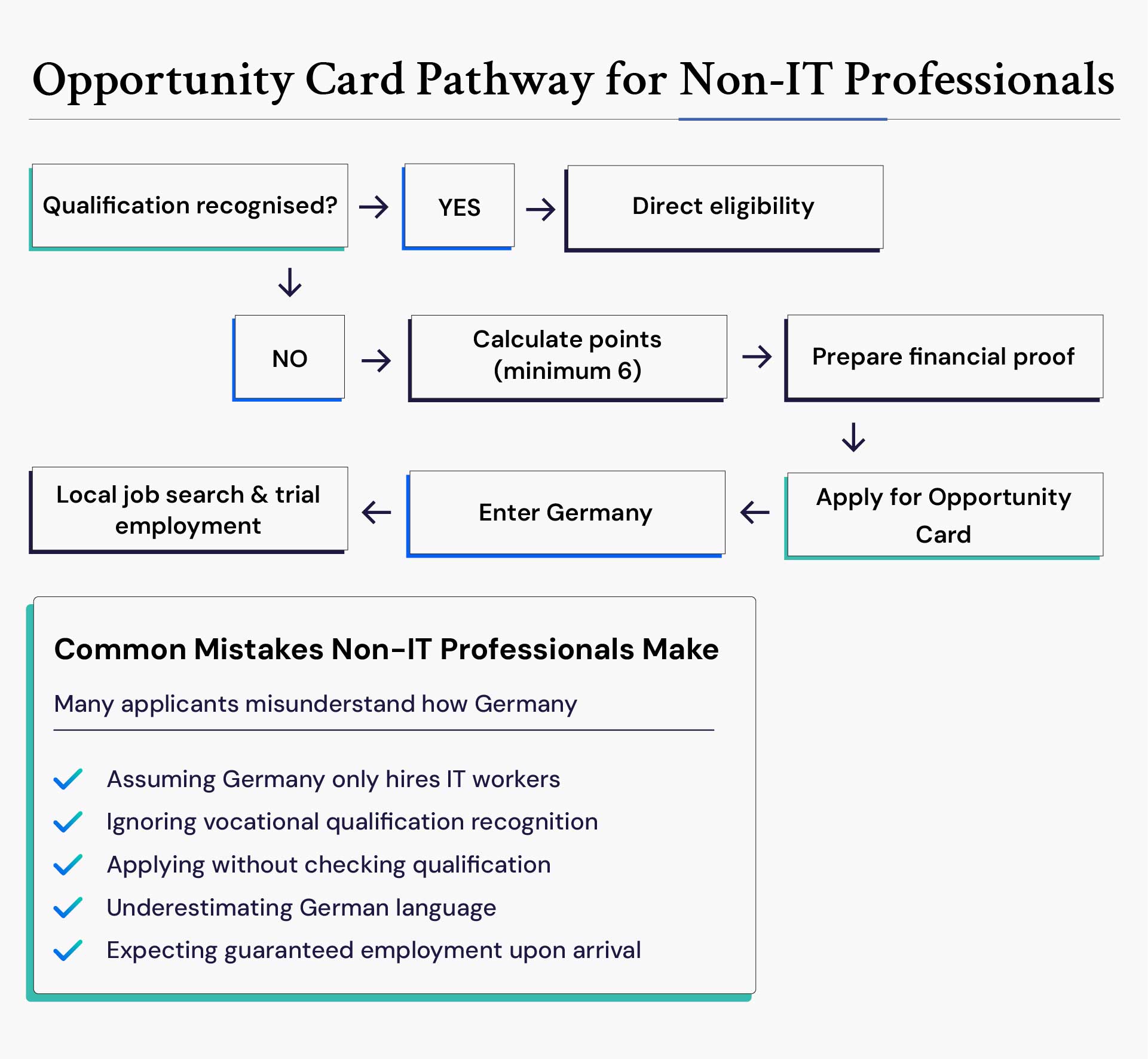
Once in Germany, Opportunity Card holders can:
This system benefits non-IT professionals because many employers prefer assessing practical skills in person rather than hiring remotely.
The Opportunity Card significantly expands access for skilled trades and applied professions.
The program works best for applicants who:
Key Takeaways
No. Many eligible roles are in healthcare, trades, logistics, manufacturing, and hospitality.
At least 6 points under the Opportunity Card scoring system.
Not always mandatory, but strongly recommended especially for non-IT roles.
No. It allows legal job searching in Germany but employment depends on skills and market demand.
Yes. Once you secure a qualifying job, you can transition to a work residence permit.
Typically up to 12 months for job search purposes.
Yes, provided the qualification meets German comparability standards.


