
Can you apply for the Germany Opportunity Card after 40? Learn about the age limit, points system, eligibility rules, and chances for experienced professionals in 2026.

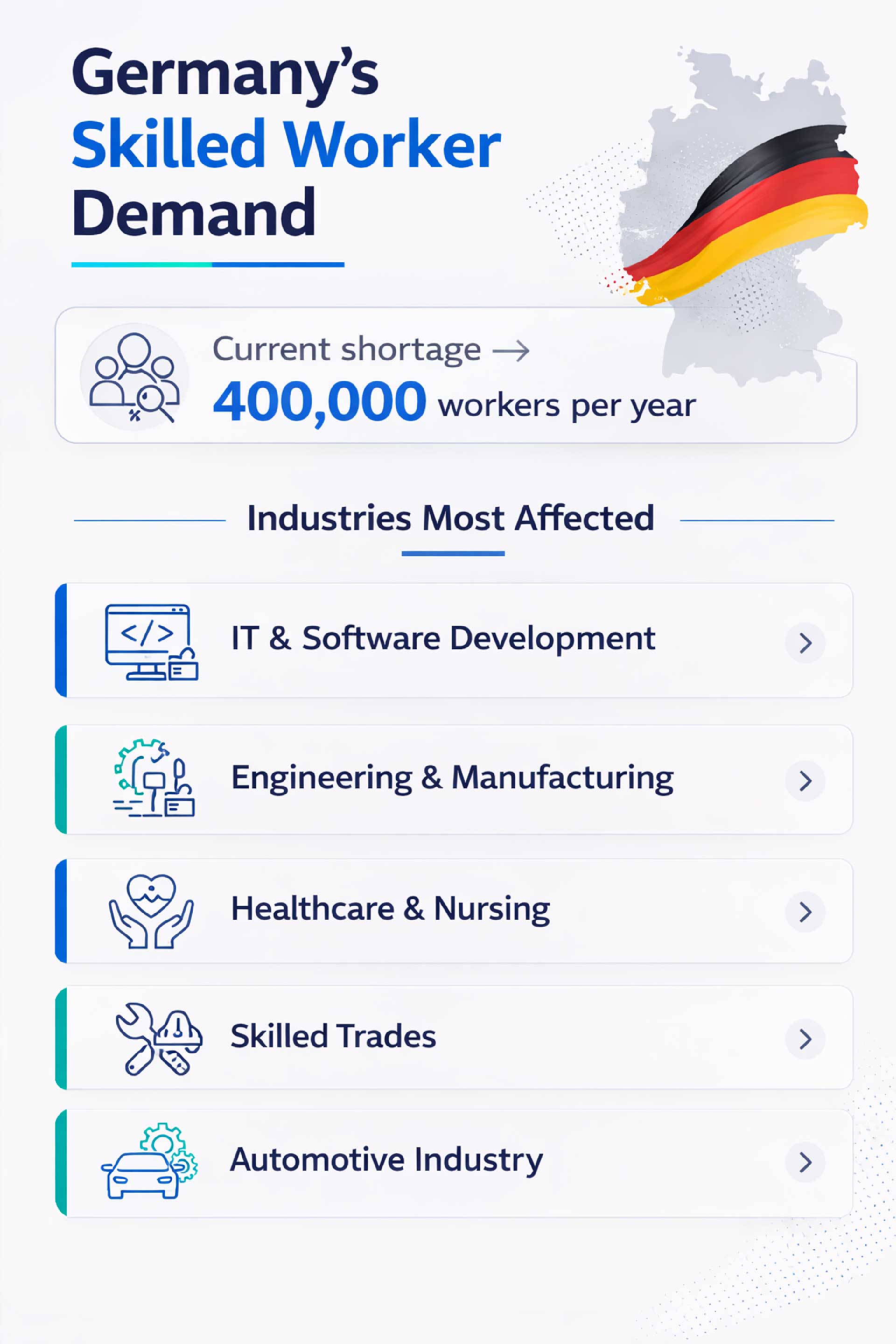
Germany is currently undergoing one of the largest labour shortages in its modern history. According to the German Federal Employment Agency, the country will require over 400,000 skilled workers annually to sustain its economy and maintain industrial growth.
To address this gap, Germany introduced the Opportunity Card (Chancenkarte) — a new immigration pathway allowing skilled professionals from non-EU countries to enter Germany without a prior job offer and search for employment.
Since its introduction, the Opportunity Card has attracted significant attention from professionals worldwide, including many applicants from India.
However, one question appears frequently among experienced professionals:
“Can I still apply for the Germany Opportunity Card after the age of 40?”
The answer is more nuanced than a simple yes or no.
While Germany’s Opportunity Card system does include age as a scoring factor, being over 40 does not automatically disqualify applicants. Instead, the system evaluates candidates through a points-based framework, where age is only one of several criteria.
This guide explains clearly and practically:
Understanding these factors is essential before deciding whether the Opportunity Card is the right pathway.
Key Facts
The Germany Opportunity Card (Chancenkarte) is a residence permit introduced to help skilled professionals from outside the European Union enter Germany to search for employment.
Unlike traditional work visas that require a confirmed job offer, the Opportunity Card allows applicants to relocate first and search for jobs after arrival.
The program operates under a points-based immigration system, evaluating candidates based on several criteria, including:
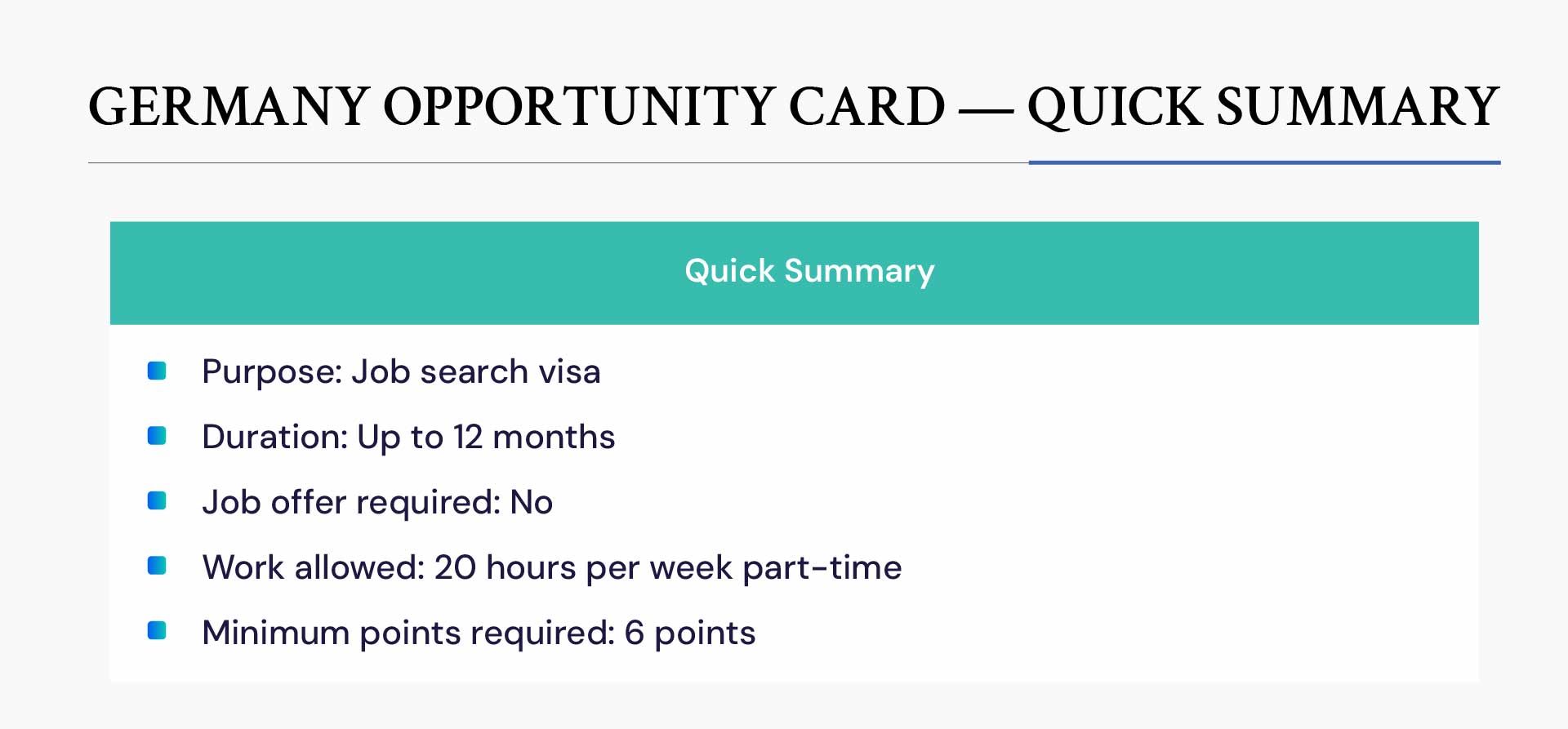
Applicants who meet the required threshold can enter Germany and spend up to one year exploring employment opportunities.
Germany’s demographic structure is changing rapidly.
According to the German Institute for Economic Research, the country faces a significant labour shortage due to:
By 2035, Germany could face a shortfall of up to 7 million workers if migration pathways are not expanded.
To address this gap, Germany introduced the Opportunity Card to attract skilled professionals globally.
The system is designed to prioritise qualified and employable candidates, rather than limiting migration strictly to individuals who already hold job offers.
One of the most common misconceptions surrounding Germany’s Opportunity Card (Chancenkarte) is that applicants above a certain age are automatically ineligible.
In reality, Germany has not introduced a strict upper age limit for the Opportunity Card.
Unlike some immigration programs in other countries that impose clear maximum age thresholds, Germany evaluates applicants through a points-based eligibility framework combined with qualification requirements.
Age is simply one factor among several criteria used to assess an applicant’s overall profile.
This means that while younger candidates may receive more points under the age category, being over 40 does not automatically disqualify you.
Germany’s immigration system is designed to prioritise skills, qualifications, and employability, rather than age alone.
As a result, applicants who may receive fewer points for age can still qualify by demonstrating strength in other areas such as:
In practice, many applicants above the age of 40 successfully meet the eligibility criteria because experience and skills often compensate for lower age-based points.
Germany’s labour market demand also plays an important role here. Experienced professionals in sectors facing skill shortages are often still competitive candidates regardless of age.

Under the Germany Opportunity Card framework, applicants must meet one of two main eligibility routes:
Direct qualification pathway (recognised skilled worker qualification) or Points-based pathway (minimum 6 points)
The points-based pathway evaluates candidates across several categories such as:
Age contributes to the total points score but does not dominate the assessment.
Younger applicants generally receive slightly higher points because they are expected to have longer potential working years within the labour market.
A simplified reference of age-related scoring typically looks like this:
However, it is important to understand that the difference in points is not large enough to automatically exclude older candidates.
For example, applicants above 40 can compensate through:
In other words, the Opportunity Card system is designed to reward employability rather than youth alone.
Yes and in many cases they do.
Applicants over the age of 40 can still meet the minimum six-point eligibility threshold required under the points-based pathway.
Experienced professionals often have advantages in areas that carry significant weight in the system, such as professional expertise and qualifications.
For example:
A professional aged 42 with:
may still accumulate enough points to qualify for the Opportunity Card.
In addition to the points system, experienced candidates may also benefit from stronger employability in specialised sectors, which can improve their chances of securing a job once they arrive in Germany.
Germany’s labour market currently faces shortages in fields such as engineering, IT, and technical manufacturing — areas where experienced professionals are particularly valued.
Applicants above 40 can significantly strengthen their Opportunity Card profile by focusing on key eligibility factors that carry strong weight within the immigration framework.
Educational qualifications recognised under German standards are one of the most important eligibility criteria.
Degrees assessed as equivalent to German qualifications (typically verified through Anabin recognition or comparable evaluation systems) significantly improve an applicant’s profile.
Fields that currently show strong labour demand include:
Applicants with recognised academic qualifications often have an advantage because these credentials indicate that they meet Germany’s skilled worker standards.
Extensive professional experience can strongly compensate for age-related point reductions.
Germany’s labour market values practical expertise and specialised skills, particularly in industries facing workforce shortages.
Examples of sectors with consistent demand include:
Applicants with 10+ years of relevant experience may find that their professional background becomes a significant advantage during job search.
German language ability significantly improves both eligibility and employability.
Even basic German language proficiency (A1 or A2) can contribute to points in the Opportunity Card system.
More importantly, language ability signals to employers that the applicant is prepared to integrate into the workplace and local society.
Higher levels of German proficiency (B1 or B2) can further increase job prospects, particularly in sectors requiring customer interaction or regulatory compliance.
Applicants must demonstrate that they can support themselves financially while searching for employment in Germany.
Financial proof ensures that migrants can manage living costs without relying on public welfare systems.
Accepted financial proof options may include:
Preparing financial documentation early can significantly reduce delays during the visa process.
Germany requires Opportunity Card applicants to demonstrate financial self-sufficiency during their job search period.
The most common way to provide this proof is through a blocked account (Sperrkonto).
For 2026, the financial requirement is approximately:
Once the applicant arrives in Germany, the funds are released in controlled monthly withdrawals.
This ensures that applicants can cover basic living expenses such as accommodation, food, transportation, and insurance while they search for employment.
One of the advantages of the Opportunity Card is that holders are allowed to work part-time while searching for full-time employment.
Opportunity Card holders may work:
This flexibility allows applicants to support themselves financially and gain exposure to the German labour market.
Part-time work may also help applicants build local experience and professional networks while continuing their job search.
Professionals above the age of 40 often bring advantages that younger candidates may not yet possess.
These advantages include:
Many German companies value practical experience and specialised skill sets, particularly in sectors requiring technical expertise.
In industries such as engineering, manufacturing, and IT, experienced professionals can remain highly competitive candidates.
Although age alone does not prevent eligibility, certain practical challenges may arise for older applicants.
These may include:
However, professionals with strong technical backgrounds, specialised expertise, and relevant qualifications can still remain competitive in the German labour market.
The Germany Opportunity Card can still be a viable pathway for experienced professionals who meet the eligibility requirements.
Applicants who may still benefit include:
Individuals who combine education, experience, language skills, and financial readiness can still reach the required eligibility threshold and explore employment opportunities in Germany.
Yes. There is no official maximum age limit for the Germany Opportunity Card. Age is only one factor in the points-based eligibility system. Applicants over 40 can still qualify if they meet the minimum points requirement through qualifications, work experience, language skills, and financial readiness.
It can be slightly more competitive because younger applicants receive more points for age. However, candidates over 40 can compensate with strong professional experience, recognised degrees, and language skills, which often carry significant weight in the evaluation.
Your chances depend on your overall profile rather than age alone. Applicants over 40 with:
can still qualify successfully under the points-based system.
No. Germany does not reject applicants simply because of age. The immigration system evaluates skills, employability, and qualifications, not just age.
Applicants above 40 can still receive the Opportunity Card if they meet the eligibility criteria.
Currently, Germany has not set a fixed maximum age limit for the Opportunity Card. Age influences the points system, but it does not automatically disqualify applicants.
Yes. A 45-year-old applicant can still apply if they meet the eligibility requirements.
Applicants with strong professional backgrounds, recognised qualifications, and financial stability may still accumulate enough points to qualify.
For professionals with strong qualifications and work experience, Germany can still be a viable destination. The country faces ongoing skilled worker shortages, especially in sectors like:
Experienced professionals in these sectors may still find opportunities.
Yes. Professional work experience is one of the most valuable factors in the Opportunity Card evaluation. Applicants with extensive experience in high-demand industries may offset lower age-related points.
German language skills are not always mandatory but can significantly improve your eligibility and job prospects.
Even basic German proficiency (A1 or A2) may contribute points under the system and make it easier to integrate into the job market.
Yes. The Opportunity Card specifically allows qualified professionals to enter Germany without a job offer and search for employment after arrival.
The visa typically allows up to 12 months for job search, during which holders may also work part-time.
Yes. Opportunity Card holders are allowed to work up to 20 hours per week while searching for a full-time job. This helps support living expenses and allows applicants to gain local work exposure.
Not necessarily. While some entry-level roles may favour younger candidates, many German employers actively seek experienced professionals with specialised skills, particularly in engineering, IT, and technical sectors.
For professionals with strong qualifications and relevant work experience, the Opportunity Card can still be a valuable pathway to explore employment opportunities in Germany.
However, applicants should realistically evaluate their profile, industry demand, and language readiness before applying.
Applicants applying through the points-based pathway must score at least 6 points based on criteria such as education, experience, age, language ability, and previous connections to Germany.
Common mistakes include:
Successful applicants usually prepare their qualification recognition, language skills, and financial documentation in advance.
Yes. Germany’s labour market values skills and experience, especially in sectors facing workforce shortages. Many companies prioritise technical expertise and professional capability over age.
Germany’s Opportunity Card may be more accessible for some professionals because it does not impose a strict age limit, whereas immigration programs in countries like Canada and Australia often reduce eligibility significantly after certain ages.


