
Germany’s Opportunity Card lets skilled Indians enter Germany without a job offer to search for employment through a points-based system.

Last updated for 2026 Germany skilled migration assessment patterns
Germany has introduced the Opportunity Card (Chancenkarte) to attract skilled foreign professionals amid a growing labour shortage. For Indian professionals and graduates, the Opportunity Card opens a legal, points-based pathway to enter Germany without a prior job offer and search for employment on the ground.
In 2026, the Germany Opportunity Card has become a key mobility route for Indians seeking work opportunities in Europe, especially in sectors facing acute skill shortages.
This guide explains what the Germany Opportunity Card is, how the points system works, eligibility for Indians, benefits, application process, and key considerations for 2026 applicants.
Germany Opportunity Card (Chancenkarte) – Key Facts (2025–2026)
Source: German Federal Government – Skilled Immigration Act
The Germany Opportunity Card (Chancenkarte) is a temporary residence permit for job search introduced under Germany’s revised Skilled Immigration Act that allows qualified foreign nationals to enter Germany for the sole purpose of searching for employment, even if they do not have a job offer at the time of application.
This represents a significant shift from Germany’s traditional immigration model. Historically, most German work visas required applicants to first secure a binding employment contract from a German employer before they could apply for a visa. While this approach worked for employer-driven hiring, it limited access for skilled professionals who were employable but unable to secure jobs remotely.
The Opportunity Card addresses this gap by allowing skilled individuals to be physically present in Germany, attend interviews, interact with employers, and search for suitable roles from within the country, which aligns better with how German employers typically recruit.
There are two eligibility pathways under the Opportunity Card:
Pathway 1: Direct Eligibility through Qualification Recognition
If an applicant’s university degree or vocational qualification is fully recognised in Germany (i.e., equivalent to the German education system), they can apply directly for the Germany Opportunity Card without using the points system.
Qualification recognition can be checked through official databases such as ANABIN or through authorised recognition bodies.
Pathway 2: Points-Based Eligibility Route
If an applicant’s qualification is partially recognised or not recognised, they must qualify through Germany’s points-based system. Under this route, eligibility is assessed based on employability factors such as:
Recognition in this case is typically assessed through bodies such as ZAB / DAB, depending on the profile.
The Germany Opportunity Card is a legal and structured pathway that allows skilled professionals to enter Germany and search for jobs across a wide range of sectors. Applicants do not need to belong strictly to a listed labour-shortage occupation to apply.
It does not provide permanent residence or guaranteed employment. Instead, it offers a time-bound, regulated opportunity to secure suitable employment. If the applicant successfully secures a job that meets legal requirements, the Opportunity Card can then be converted into a proper work residence permit, such as a standard German work visa or the EU Blue Card.
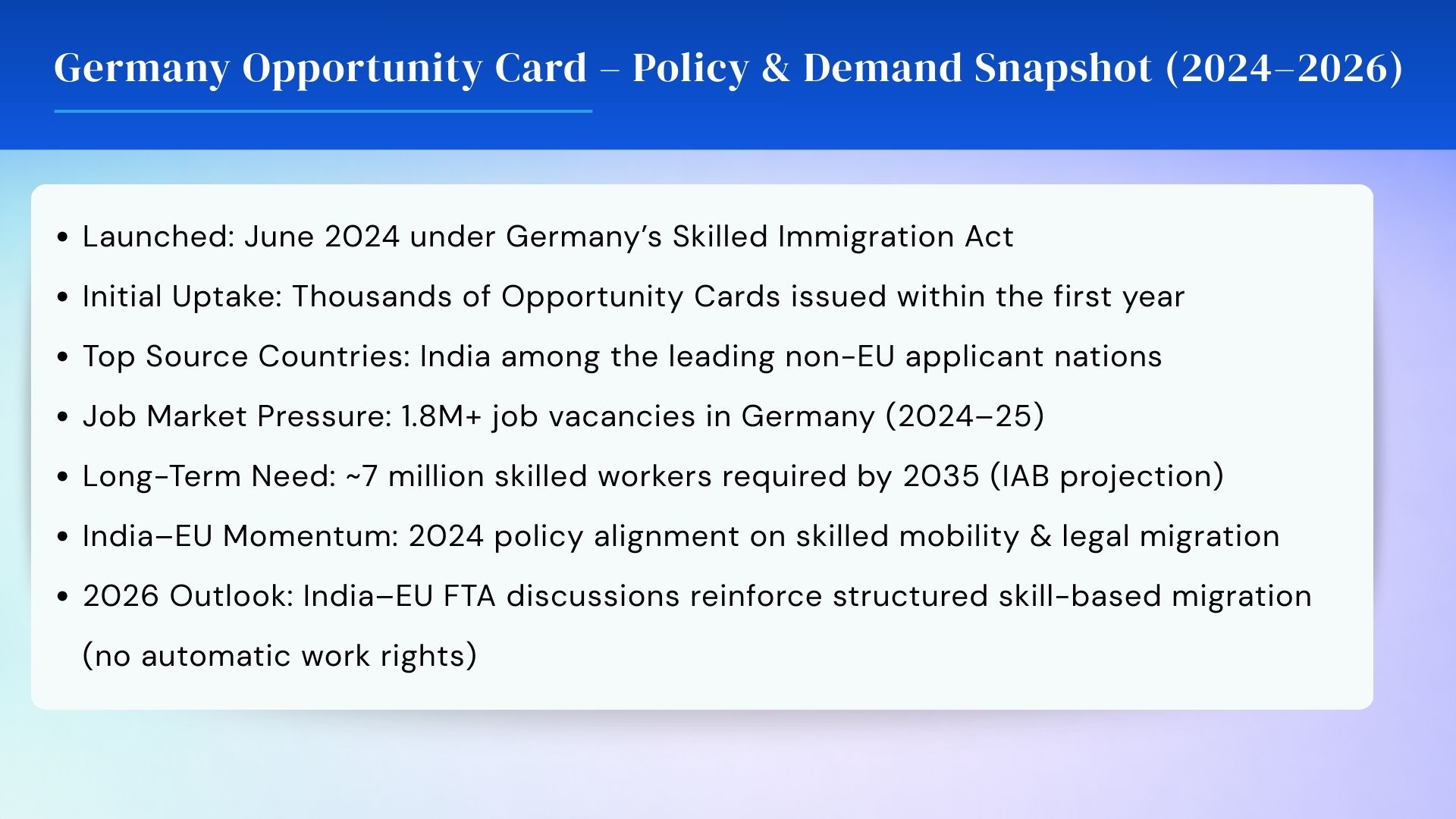
Germany introduced the Opportunity Card in response to a long-term structural labour shortage, not a temporary economic fluctuation.
The root cause of this shortage lies in demographic change. Germany has one of the world’s fastest-ageing populations, with a growing proportion of workers reaching retirement age and fewer young workers entering the labour force to replace them. This imbalance has created persistent gaps across multiple sectors of the economy.
Official labour market data highlights the scale of the issue:
According to projections from the Institute for Employment Research (IAB), Germany will require at least 7 million additional skilled workers by 2035 simply to maintain current levels of economic output. Without sustained immigration, labour shortages are expected to worsen, directly impacting productivity, public services, and long-term growth.
The Germany Opportunity Card offers practical, regulated advantages for skilled professionals seeking employment in Germany. These benefits provide access and flexibility, not guarantees.
No Job Offer Required Before Travel
Applicants can enter Germany without securing a job offer in advance. This allows candidates to attend interviews, meet employers in person, and search for suitable roles locally, an important advantage since many German employers prefer hiring candidates who are already in the country. This benefit removes an early barrier but still requires applicants to be job-ready and prepared.
Legal Stay in Germany for Job Search
The Opportunity Card grants a legal residence permit for up to 12 months to search for employment. During this period, applicants can lawfully stay in Germany, apply for jobs, and engage with the labour market without relying on short-term visitor visas.
Permission to Work Part-Time (20 Hours per Week)
Cardholders are allowed to work part-time for up to 20 hours per week. This helps support living expenses and provides exposure to the German work environment. Full-time employment is not permitted until the card is converted to a work residence permit.
Pathway to Long-Term Work Residence
If the applicant secures a qualifying job, the Opportunity Card can be converted into a German Work Visa or the EU Blue Card. Long-term residence options may follow over time, subject to employment continuity and legal requirements.
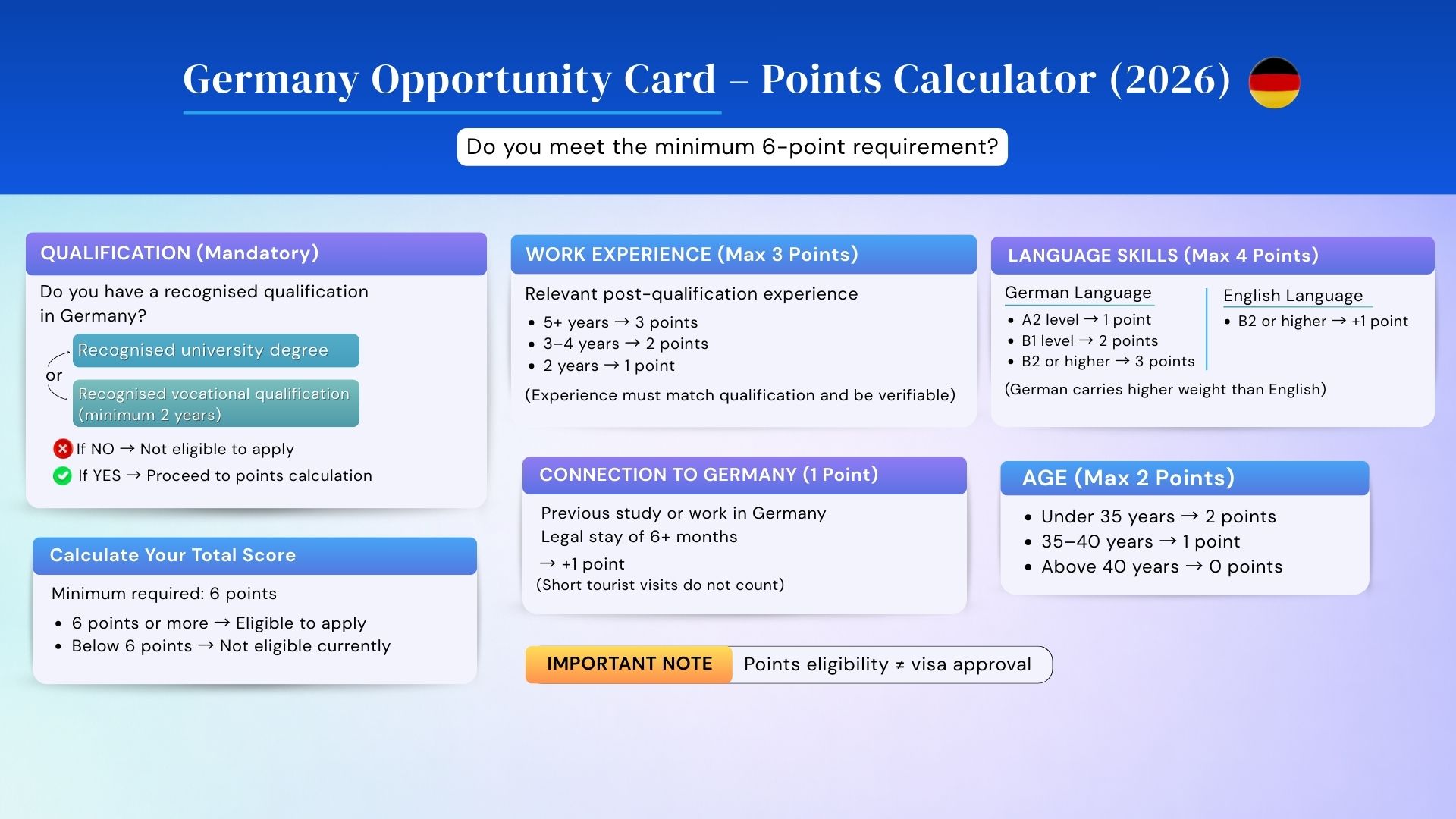
To qualify for the Germany Opportunity Card (Chancenkarte), applicants must score a minimum of 6 points under Germany’s official points-based eligibility system.
It is important to understand that the points system is not a competitive ranking system where higher scores guarantee approval. Instead, it is a threshold-based filter used to identify candidates who meet Germany’s minimum employability standards.
Scoring 6 points makes an applicant eligible to apply, but the final decision still depends on overall profile assessment, documentation quality, and credibility.
(Each criterion is explained in detail below.)
Get your profile reviewed by a Germany Opportunity Card expert to understand your eligibility and next steps clearly.
Qualification recognition is the first and most important step in the Germany Opportunity Card process. How your education is recognised in Germany determines which eligibility route applies to you. There are two possible pathways:
Option 1: Fully Recognised Qualification (Direct Eligibility)
If your university degree or vocational qualification is fully recognised as equivalent to the German education system, you can apply for the Germany Opportunity Card without using the points system. Recognition is typically verified through Germany’s official databases such as ANABIN. In this case, eligibility is established based on qualification recognition alone, and applicants can proceed directly with the Opportunity Card application, subject to other standard requirements.
Option 2: Partially Recognised or Not Recognised Qualification (Points-Based Route)
If your qualification is partially recognised or not listed as equivalent, you may still qualify for the Opportunity Card through the points-based system. Under this route, eligibility is assessed using factors such as work experience, language skills, age, and prior connection to Germany. Qualification assessment for this route is typically handled through recognised evaluation bodies such as ZAB or DAB, depending on the profile.
Work experience points are awarded based on the length and relevance of professional experience gained after completing formal education.
Germany places strong emphasis on practical application of skills, especially in technical and professional roles.
Points are awarded as follows:
To increase your visa success chances:
Work experience gained before completing the relevant qualification is usually not counted.
Language ability is treated as a key employability indicator, not just a communication skill.
German Language Skills (Up to 3 Points)
German language proficiency carries the highest weight because:
Points are awarded as follows:
Even basic German demonstrates readiness to integrate and significantly improves employability.
English Language Skills (1 Point)
Applicants may receive 1 additional point for strong English proficiency:
While strong English skills support communication and employability, developing German language ability is a key advantage for broader job prospects in Germany’s local labour market.
Age points reflect Germany’s focus on long-term workforce participation.
Younger applicants are statistically more likely to:
Points are awarded as follows:
Applicants above 40 years are not automatically disqualified, but must compensate with stronger experience, language skills, or other criteria.
Applicants can earn 1 additional point if they have prior exposure to Germany.
This includes:
This criterion signals:
Short tourist visits usually do not qualify for this point.
How the Points System Works in Practice
The points system is designed to evaluate overall employability, not excellence in a single area.
For example:
Both may still reach the 6-point threshold through different combinations.
Germany intentionally allows multiple pathways to eligibility, recognising that skilled profiles are diverse.
Important Clarifications About the Points System
The Opportunity Card is therefore best suited for applicants who are job-ready, prepared, and realistic about the German labour market.
Indian nationals applying for the Germany Opportunity Card must meet the following:
Core Eligibility
Financial Requirement
Applicants must show financial self-sufficiency, typically through:
(Amount subject to annual revision)
Applications are processed through German missions in India, following country-specific appointment systems.
German authorities assess:
Unlike tourist visas, this is a labour-market-aligned permit, not a general migration route.
Winny supports applicants through:
Winny’s approach focuses on clarity, compliance, and long-term planning, not promises.
Is the Germany Opportunity Card guaranteed if I score 6 points?
No. Scoring 6 points only makes you eligible to apply. Final approval depends on document verification, profile credibility, qualification recognition, financial proof, and overall employability assessment by German authorities.
Do I need a job offer to apply for the Opportunity Card?
No. A job offer is not required at the time of application. However, applicants are expected to be job-ready and actively search for employment after entering Germany.
Can I work full-time on the Germany Opportunity Card?
No. The Opportunity Card allows only part-time work up to 20 hours per week. Full-time work is permitted only after converting to a German work residence permit.
Can I bring my spouse or family members on an Opportunity Card?
No. Family reunification is not permitted while holding an Opportunity Card. It becomes possible only after switching to a qualifying work residence permit.
Is German language mandatory for the Opportunity Card?
German language skills are not strictly mandatory if other criteria compensate. However, even basic German significantly improves employability, integration, and approval confidence.
How long can I stay in Germany on the Opportunity Card?
The Opportunity Card is typically issued for up to 12 months. Extensions are not guaranteed and depend on individual circumstances.
Can I convert the Opportunity Card to permanent residence (PR)?
No. The Opportunity Card itself does not lead to PR. PR becomes possible only after converting to a work permit and meeting long-term residence requirements.
What happens if I do not find a job during the validity period?
If no qualifying job is secured, the Opportunity Card expires and the applicant is expected to leave Germany. It does not automatically extend or convert.
Is the Opportunity Card better than the Job Seeker Visa?
The Opportunity Card offers additional flexibility, including part-time work and a structured points system. However, both routes require serious preparation and realistic job prospects.


