
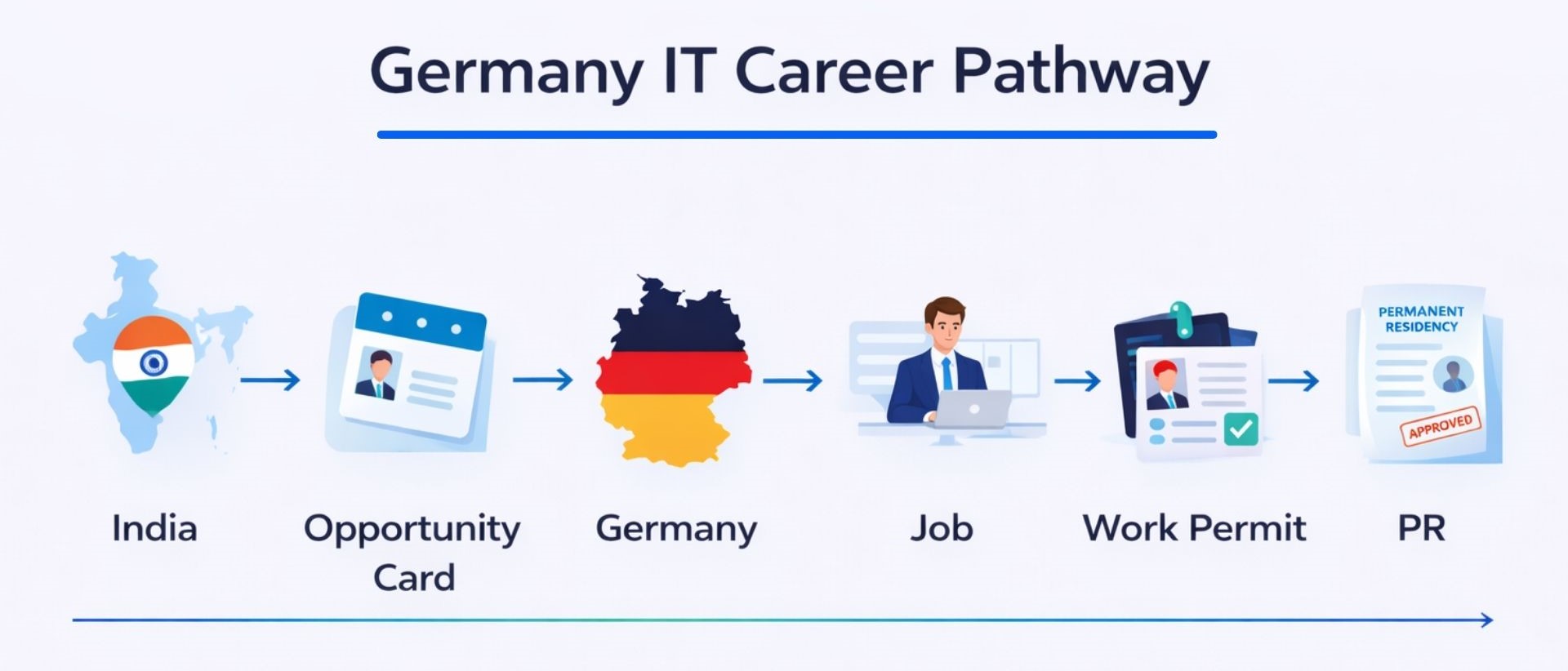
Germany’s Opportunity Card allows IT professionals to enter without a job offer and access a growing tech job market driven by long-term digital transformation.
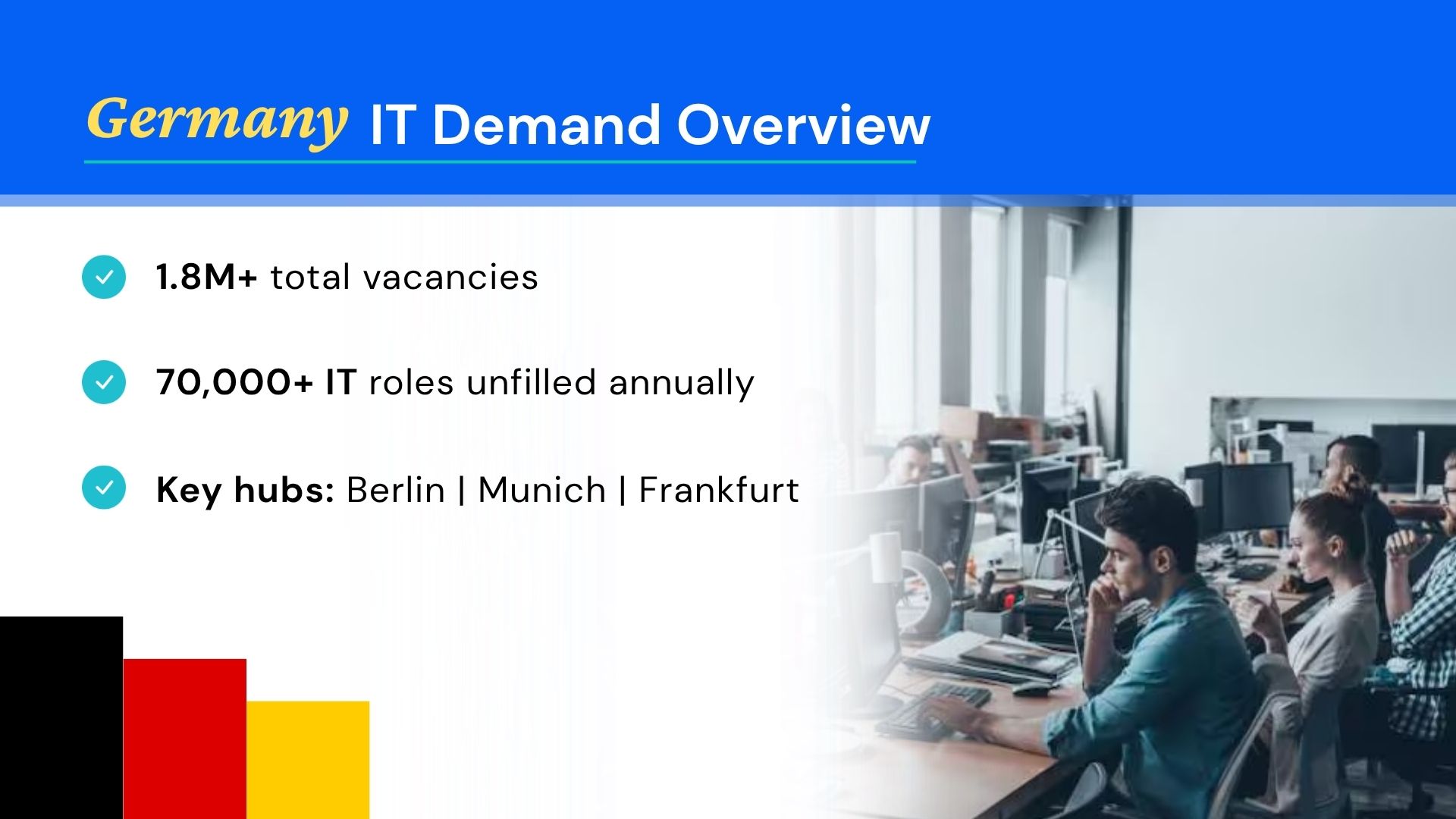
Germany is currently facing a significant shortage of skilled professionals, especially in the technology sector. With over 1.8 million job vacancies and a rapidly expanding digital economy, the demand for IT professionals continues to rise across industries.
According to industry estimates, Germany requires tens of thousands of IT specialists every year to support areas like software development, cloud infrastructure, artificial intelligence, and cybersecurity.
For Indian IT professionals, this presents a clear opportunity but also a challenge.
Traditionally, working in Germany meant securing a job offer before applying for a visa. However, many skilled professionals find it difficult to get selected remotely due to:
To address this gap, Germany introduced the Opportunity Card (Chancenkarte) — a structured pathway that allows professionals to enter Germany without a job offer and search for jobs directly within the country.
This guide explains how this works specifically for IT professionals, along with eligibility, salaries, skills, and the complete pathway.
Germany’s demand for IT professionals is driven by long-term structural and economic changes rather than short-term hiring trends. As the country continues to evolve into a digitally advanced and innovation-led economy, the need for skilled technology professionals is increasing across multiple industries.
Germany is undergoing a large-scale digital transformation that extends beyond technology companies into traditional sectors such as manufacturing, automotive, healthcare, and finance. Organisations are actively modernising their operations by adopting cloud infrastructure, artificial intelligence, automation, and data-driven systems. Even industries that were historically hardware-focused are now becoming increasingly software-driven, requiring professionals who can design, build, and manage digital solutions. This shift has created a sustained and growing demand for IT talent across a wide range of roles.
At the same time, Germany is facing a long-term shortage of skilled professionals due to demographic changes. An aging population and declining workforce participation mean that fewer individuals are entering the labour market while a significant number of experienced professionals are approaching retirement. This imbalance has created a widening gap between the demand for skilled talent and the available domestic workforce. In high-demand fields like IT, where skills evolve rapidly, this gap is even more pronounced, leading Germany to increasingly rely on international professionals to support its economic growth.
Germany’s technology ecosystem has expanded significantly over the past decade, positioning the country as a growing hub for innovation and digital development. Cities such as Berlin, Munich, and Frankfurt have attracted startups, global technology companies, and research-driven industries, creating dynamic environments for technology professionals. This expansion has not only increased the number of job opportunities but has also led to more international and English-friendly workplaces, making it easier for skilled professionals from countries like India to integrate into the German job market.
What This Means for IT Professionals
These factors indicate that Germany’s demand for IT professionals is structural and long-term. For skilled individuals, this translates into consistent opportunities across industries, greater flexibility in career choices, and the ability to build a stable and growth-oriented career in one of the world’s most advanced economies.
Germany’s demand for IT professionals is not limited to a single role or niche. As digital transformation expands across industries, companies are actively hiring across multiple domains, from software development to cloud infrastructure and cybersecurity.
The demand is particularly strong for professionals who combine technical expertise with practical experience, as organisations increasingly look for candidates who can contribute from day one.
Core IT Roles with Salary Ranges
Specialised & Emerging High-Paying Roles
As Germany moves deeper into digital transformation, certain niche roles are seeing faster salary growth and higher demand.
AI engineers alone average around €84,500 annually, with higher growth at senior levels
What Employers Look For
German employers focus less on theoretical knowledge and more on practical, job-ready skills. While requirements vary by role, certain expectations remain consistent across the IT sector.
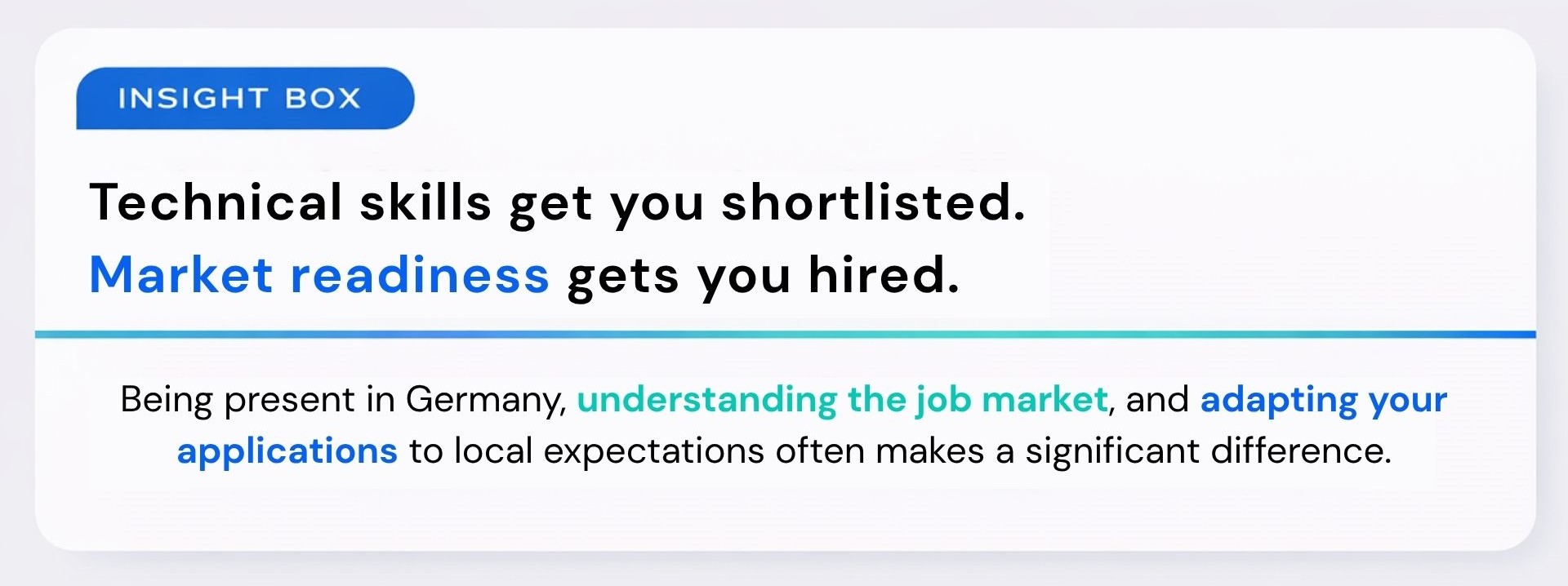
They typically look for professionals with 2–5 years of relevant experience, a strong technical stack such as Java, Python, cloud platforms (AWS/Azure), and the ability to solve real-world problems. While English is widely accepted in many tech roles, basic German language skills can significantly improve employability and workplace integration, especially outside purely international companies.
Yes — but only through specific, structured pathways.
Traditionally, professionals needed a confirmed job offer before applying for a work visa. However, this model often limits opportunities for skilled individuals who are employable but unable to secure jobs remotely.
To address this gap, Germany introduced a more flexible approach.
What Is the Germany Opportunity Card?
The Germany Opportunity Card (Chancenkarte) is a 12-month residence permit that allows skilled professionals to enter Germany and search for employment without a job offer.
This represents a shift from an employer-driven system to a candidate-access model, where professionals can directly engage with the job market.
What Makes It Different
This is the conventional pathway followed by most applicants.
How it works:
You must first secure a job offer from a German employer. Once selected, the employer supports your visa process, after which you move to Germany.
Limitations:
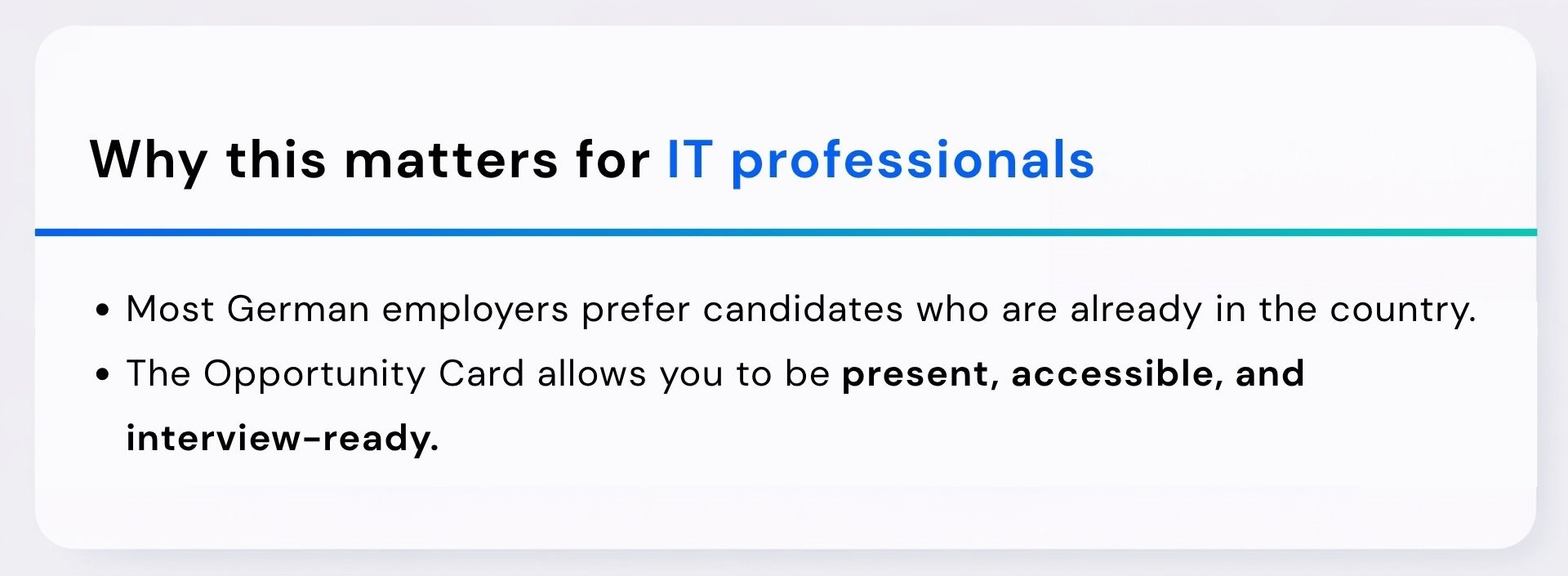
This approach often results in lower success rates for candidates applying from abroad, as employers tend to prioritise candidates who are already available locally. It also limits flexibility, as your visa is tied to a specific employer and role.
The Opportunity Card offers a more flexible and practical route for skilled IT professionals.
How it works:
You apply for the Opportunity Card without a job offer, move to Germany, and search for jobs directly within the local market.
Why it is more effective:
Being physically present allows you to attend interviews, network, and explore multiple opportunities, significantly increasing your chances of securing employment.
Comparison Overview
To apply for the Opportunity Card, candidates must meet specific eligibility requirements based on employability.
Core Requirements
Applicants must hold a recognized academic or professional qualification, meet the minimum eligibility threshold (typically 6 points under the points-based system, where applicable), and demonstrate financial stability along with valid health insurance.
What Strengthens Your Profile
A strong application is not just about meeting minimum requirements. Profiles that perform better typically include relevant IT experience (2–5+ years), skills aligned with current market demand, basic German language ability, and a clear career direction that fits the German job market.
Germany Opportunity Card Points System
The Germany Opportunity Card uses a points-based system to assess whether a candidate is employable within the German labour market. It is not a competitive ranking system where higher points guarantee selection. Instead, it works as a minimum eligibility filter — if you meet the required threshold, you can apply.
Applicants must score at least 6 points based on a combination of factors such as qualifications, work experience, language skills, and overall profile strength.
Points Breakdown (2026)
The Opportunity Card process is structured and sequential. Each stage plays a role in ensuring your application is both compliant and aligned with German requirements.
Your academic or professional qualification is evaluated to determine whether it is equivalent to German standards.
This step is critical because it decides:
Recognition is typically checked through official databases like ANABIN or through authorised evaluation bodies.
Once your qualification status is clear, your profile is assessed to determine your eligibility pathway.
You may qualify through:
At this stage, factors such as experience, language, and age are evaluated together.
All required documents are prepared in a structured and compliant format.
This typically includes:
Proper documentation is essential, as inconsistencies or gaps can affect the outcome.
Your application is submitted through the German Embassy or Consulate.
This stage includes:
Processing timelines typically range from 3 to 6 months, depending on documentation quality and embassy scheduling.
Once approved, you receive a residence permit that allows you to enter Germany and stay legally for up to 12 months.
During this period, you are permitted to:
After arrival, your focus shifts to actively engaging with the German job market.
This includes:
Being physically present significantly improves response rates and hiring chances.
Once you secure a qualifying job, your Opportunity Card can be converted into a German work residence permit or EU Blue Card, depending on your salary and role.
This step transitions you from job search status to long-term employment and opens pathways toward residency.
To apply for the Germany Opportunity Card, applicants must demonstrate that they can financially support themselves during their stay in Germany while actively searching for a job. Since this pathway does not require a job offer at the time of application, financial stability becomes a key part of the assessment.
Applicants are generally required to show approximately €1,027 per month, which covers basic living expenses such as accommodation, food, transportation, and health insurance. This amount is calculated based on Germany’s standard cost of living and may be updated periodically.
How Financial Proof Is Shown
Financial stability is typically demonstrated through one of the following:
Financial preparation is not just a formal requirement. It reflects your ability to manage your stay independently while focusing on your job search. Since the Opportunity Card allows you to stay in Germany for up to 12 months without full-time employment, having a clear financial plan ensures stability and allows you to approach the job market with confidence.
Key Takeaways
Navigating the Germany Opportunity Card is not just about meeting eligibility. It requires clarity on the right pathway, structured documentation, and a clear understanding of how the German job market works.
Winny approaches this as a guided, structured process, ensuring that every stage of your journey is aligned with official requirements and realistic outcomes.
What You Get with Winny
Your profile is assessed to determine whether you qualify through qualification recognition or the points-based system, helping you avoid incorrect applications.
Support in understanding and navigating recognition processes (such as ANABIN), ensuring your qualifications are aligned with German standards.
Accurate evaluation of your points and guidance on how to strengthen your profile based on official criteria.
Clear guidance on preparing proof of funds, including blocked account documentation, ensuring compliance with visa requirements.
Your documents are reviewed and aligned to reflect eligibility, intent, and consistency before submission.
Step-by-step support through the visa application process, including submission requirements and interview preparation.
Guidance on preparing for the German job market, including CV structuring, understanding platforms, and application approach.
Clarity on how to approach job search after reaching Germany and how to transition to a work permit.
Yes. Indian IT professionals can move to Germany without a job offer through the Germany Opportunity Card, which allows them to enter the country and search for jobs legally.
The Germany Opportunity Card is a 12-month residence permit that allows skilled professionals to enter Germany without a job offer and search for employment. It works through a points-based system or direct eligibility based on qualification recognition.
Applicants need a minimum of 6 points under the points-based system to qualify. However, meeting the minimum points only makes you eligible to apply — it does not guarantee approval.
Yes. Germany has strong demand for IT professionals across software development, cloud computing, data science, and cybersecurity, with competitive salaries and long-term career opportunities.
German language is not always mandatory for IT roles, especially in international companies. However, basic German (A1/A2 level) significantly improves job opportunities and integration.
Yes. Opportunity Card holders are allowed to work part-time for up to 20 hours per week while searching for a full-time job.
Once you secure a job, you can convert your Opportunity Card into a German work visa or EU Blue Card, depending on your role and salary.
Applicants typically need to show around €1,027 per month as proof of financial stability, usually through a blocked account or equivalent funds.
It depends on your situation. If you do not have a job offer, the Opportunity Card provides a more flexible pathway to enter Germany and access job opportunities directly.
No. Approval depends on eligibility, documentation quality, financial proof, and overall profile assessment. No pathway guarantees approval.


