
Germany’s Opportunity Card requires applicants to prove approximately €12,324 in liquid funds to support themselves during the 12-month job search period.

One of the most misunderstood parts of applying for Germany’s Opportunity Card (Chancenkarte) is proving financial readiness. Many applicants focus only on eligibility points and qualifications, but applications are often delayed or rejected because financial proof does not meet German visa standards.
Germany requires Opportunity Card applicants to demonstrate sufficient liquid funds to support themselves during the job search period. This requirement ensures applicants can live independently while looking for employment without relying on public welfare.
For Indian applicants especially, confusion usually arises around:
This guide explains exactly how to arrange liquid funds for the Germany Opportunity Card in 2026, using official requirements and practical examples.
Key Facts
Applicants must prove financial self-sufficiency during their stay in Germany.
Sources:
German Federal Foreign Office (Auswärtiges Amt) Make-it-in-Germany Official Portal German Embassy Visa Guidelines
The Opportunity Card allows applicants to enter Germany without a job offer. Because employment is not guaranteed immediately, immigration authorities must ensure applicants can cover:
Financial proof reduces immigration risk and demonstrates responsible migration planning.
Unlike some countries, Germany evaluates financial stability, not just total wealth.
For the Germany Opportunity Card (Chancenkarte), liquid funds refer to money that is immediately available for living expenses during your stay in Germany and can be verified by German immigration authorities.
Because Opportunity Card holders enter Germany without a confirmed job offer, applicants must prove they can financially support themselves throughout the job search period without relying on German public benefits.
The financial requirement is based on Germany’s legally defined minimum subsistence level used for long-term residence permits.
According to the German Federal Foreign Office (Auswärtiges Amt) and official visa guidance, applicants must demonstrate access to funds equivalent to approximately:
€1,027 per month (amount updated periodically)
Usually calculated for up to 12 months of stay
This equals roughly:
€12,324 total financial proof (subject to annual revision).
What “Liquid” Actually Means (From a Visa Perspective)
German authorities do not assess wealth ,they assess accessibility and usability of funds.
Liquid funds must be:
The key question visa officers evaluate is:
“Can this applicant realistically pay for housing, food, insurance, and living expenses from day one in Germany?”
Assets That Typically Qualify as Liquid Funds
Assets That Usually Do Not Qualify Alone
These may demonstrate financial strength but do not meet liquidity requirements:
German consulates prioritise financial stability over asset value.
For example:
Owning property worth ₹1 crore does not replace showing accessible cash funds.
Why Germany Uses Liquid Fund Requirements
The Opportunity Card allows applicants to stay in Germany while searching for employment. Since job placement timelines vary, financial proof ensures:
This requirement applies equally to all professions and nationalities.
For the Germany Opportunity Card (Chancenkarte), financial proof is not optional, it is a mandatory eligibility requirement.
Applicants must demonstrate they can cover their living expenses in Germany during the job search period. Since the Opportunity Card does not require a job offer before entry, German authorities require advance financial security.
As per German visa guidelines, applicants must show access to approximately:
The amount is based on Germany’s official subsistence level used across long-term residence permits.
Below are the legally recognised and commonly accepted methods of arranging liquid funds.
The blocked account (Sperrkonto) is the most widely accepted and recommended financial proof method for the Germany Opportunity Card.
It is specifically designed for visa applicants entering Germany without guaranteed employment.
What Is a Blocked Account?
A blocked account is a special bank account where:
This ensures financial discipline and guarantees subsistence during your stay.
How a Blocked Account Works – Step by Step
The exact monthly withdrawal amount aligns with the official subsistence benchmark.
Why German Authorities Prefer Blocked Accounts
From a visa officer’s perspective, blocked accounts provide:
Because of these safeguards, a blocked account is often considered the strongest and clearest financial proof for the Opportunity Card.
Important Clarifications
Another legally recognised method is the Verpflichtungserklärung, an official financial sponsorship declaration issued in Germany.
This is not a simple invitation letter.
It is a legally binding document issued by a German immigration authority.
What Is a Verpflichtungserklärung?
It is a formal declaration where a person residing in Germany commits to covering all living expenses of the applicant during their stay.
This includes:
The sponsor becomes financially responsible under German law.
Requirements for the Sponsor
The sponsor must:
The immigration office evaluates the sponsor’s income before issuing the document.
If income is insufficient, the declaration will not be approved.
When Is This Method Suitable?
This option is most practical when:
It is less commonly used than blocked accounts but fully valid when properly issued.
Some German missions may accept personal bank savings as financial proof instead of a blocked account, but this depends on local embassy instructions.
If using personal savings, the funds must:
What Visa Officers Examine in Bank Statements
Officers typically review:
Sudden unexplained deposits shortly before application may raise concerns.
If funds are transferred from family, documentation of the transfer source may be required.
Applicants may combine funding methods if needed, provided total funds meet the required amount.
Examples include:
All combined sources must:
The total accessible funds must equal or exceed the required threshold.
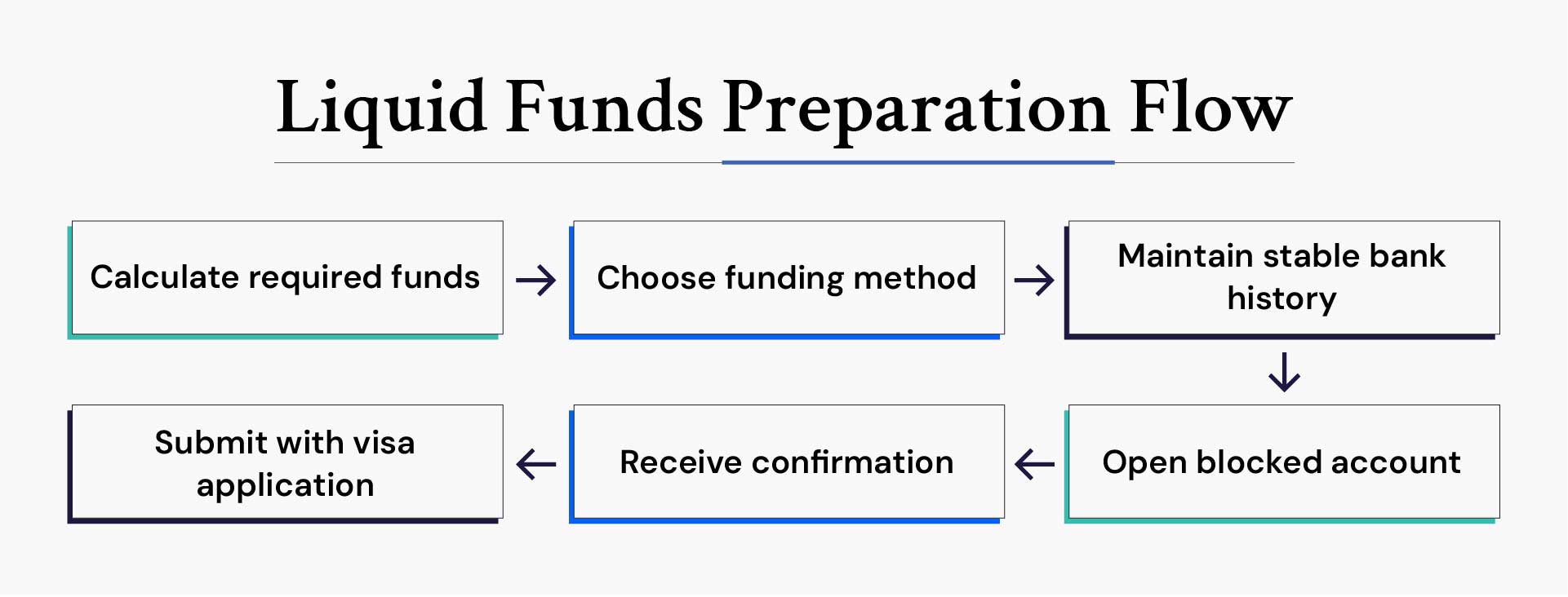
Because financial proof is a decisive factor in visa approval, applicants should follow a structured approach.
Ideally start 6–9 months before applying.
This allows time to:
Avoid:
Visa officers assess credibility, not just balance.
Be prepared to provide:
This strengthens financial authenticity.
In most cases:
For blocked accounts, obtain the official confirmation letter.
For sponsorship, ensure the Verpflichtungserklärung is properly issued.
Submit these documents with your visa application.
Practical Reality: Why Financial Credibility Matters
Germany does not assess whether you are wealthy.
Germany assesses whether:
A strong financial file significantly improves overall visa credibility.
German visa assessments focus heavily on financial credibility and transparency.
Visa officers typically assess five factors:
Approval depends on whether financial readiness appears sustainable and realistic.
Costs vary by city, with smaller cities generally more affordable than Munich or Frankfurt.
Non-IT professionals may take slightly longer to secure employment due to:
Having proper liquid funds allows applicants to focus on integration rather than financial pressure.
Key Takeaways
Applicants must show approximately €1,027 per month, typically calculated for 12 months, which equals around €12,324 total funds. The exact amount may change annually based on Germany’s official subsistence benchmark.
A blocked account (Sperrkonto) is not legally mandatory in every case, but it is the most widely accepted and safest method of financial proof. Some German embassies may accept personal savings if they clearly meet liquidity and documentation requirements.
Yes, but only if the fixed deposit is withdrawable and liquid. You may be required to show proof that the funds can be accessed and transferred. Non-withdrawable or locked investments may not qualify as liquid funds.
Yes, but the funds must be:
Unexplained third-party transfers may raise questions during visa review.
If you cannot demonstrate the full required amount through acceptable methods (blocked account, sponsorship, or documented savings), your visa application may be refused due to insufficient financial proof.
Partial funds are generally not accepted unless properly combined and documented.
No. While Opportunity Card holders can work up to 20 hours per week, expected future income cannot replace upfront financial proof. Funds must be shown before visa approval.
Yes. Officers typically review:
Sudden unexplained deposits shortly before application may create credibility concerns.
Showing slightly higher funds can provide a buffer for exchange rate fluctuations. However, approval is based on sufficiency and legitimacy, not excess wealth.
No. Property valuation, land ownership, or gold assets do not qualify as liquid funds unless converted into accessible bank balances. Germany requires usable financial resources, not asset value.
A Verpflichtungserklärung is a legally binding financial sponsorship declaration issued by a German immigration office. It is suitable if a sponsor living in Germany is financially eligible and willing to assume responsibility for your expenses.
There is no officially stated duration, but maintaining stable savings for several months before application strengthens financial credibility and reduces risk of scrutiny.
Yes, provided:
The final amount must equal or exceed the official subsistence requirement.
The most common issues include:
Financial transparency is critical.


