
Discover if education in Germany is free for Indian students. Learn tuition fees, living costs, blocked account requirements, and total study expenses in 2026.

Germany has built one of the most structured and policy-driven higher education systems in Europe. With over 450,000 international students enrolled, the country continues to attract applicants from across the world particularly from India because of its publicly funded university model and strong employment-linked migration pathways.
For Indian students and families planning overseas education, one question comes up repeatedly:
Is education in Germany really free?
The short answer:
Tuition at most public universities is free.
But studying in Germany is not cost-free.
Germany operates on a principle of financial self-sufficiency. While tuition fees are minimal or absent at public universities, students must demonstrate that they can support themselves during their stay. Living costs, health insurance, visa requirements, and regulated financial proof all form part of the real cost structure.
This guide breaks down the complete financial picture for 2026 — clearly, accurately, and practically.
Key Facts
Understanding these elements helps avoid confusion, financial underestimation, and visa delays.
Germany has become one of the most attractive study destinations for Indian students over the past decade. According to the German Academic Exchange Service (DAAD), Germany currently hosts over 450,000 international students, and India is among the top three source countries, with more than 42,000 Indian students enrolled across German universities.
A major reason behind this surge is Germany’s public-funded higher education system, which allows students to access high-quality education with minimal or no tuition fees.
Most state-run public universities in Germany do not charge tuition fees for Bachelor’s programs and many consecutive Master’s programs. Importantly, this benefit applies not only to German or EU students but also to international students from countries such as India.
This policy was reinstated after Germany abolished general tuition fees in most federal states, recognising higher education as a public investment in knowledge, research, and economic development rather than a revenue-generating sector.
However, the phrase “free education in Germany” is often misunderstood.
Germany removes tuition fees, but it does not remove financial responsibility for students.
Before receiving a German student visa, applicants must demonstrate that they can support themselves during their stay. This ensures students do not depend on public welfare systems and can manage their essential living expenses independently.
For Indian students, this means preparing financially for several key costs beyond tuition.
Students must still:
In simple terms:
Germany removes tuition fees not the cost of living.
Understanding this distinction early helps students plan realistically and avoid financial surprises after arriving in Germany.

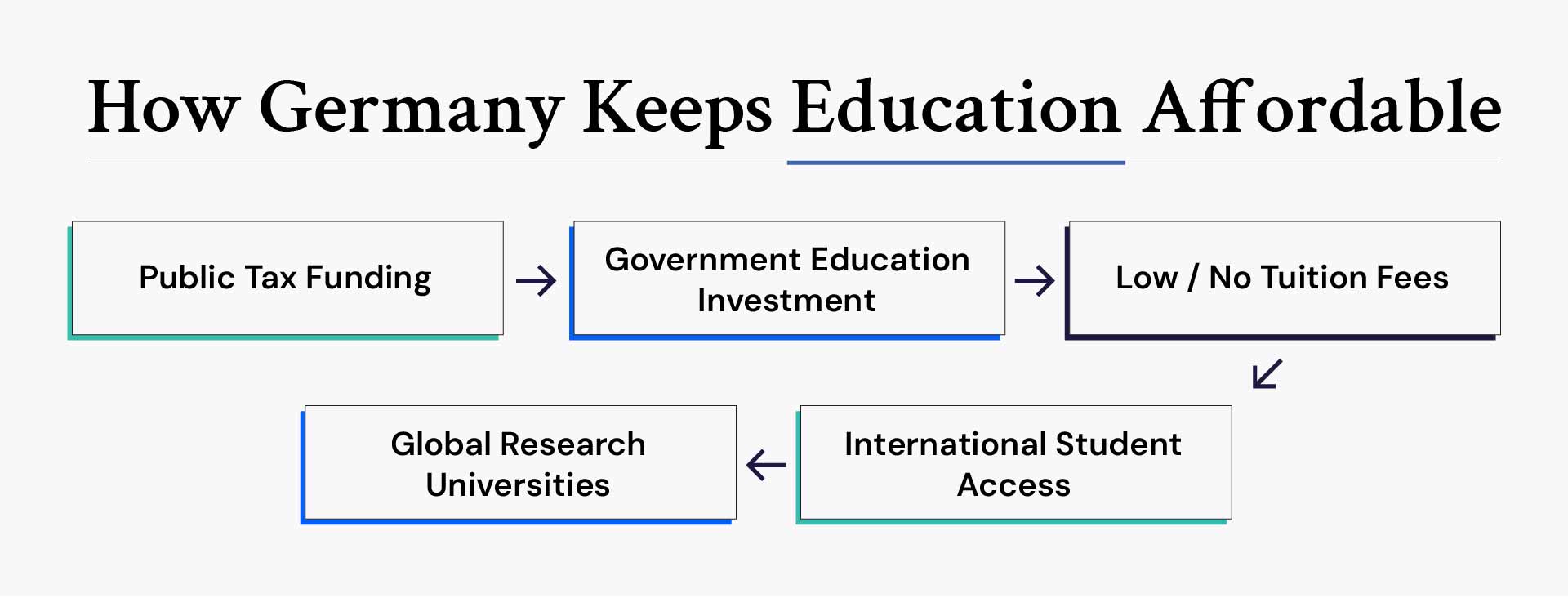
Germany’s higher education system is funded primarily through state taxation and government education budgets. This public funding allows universities to operate without relying heavily on tuition fees.
Because of this structure:
Germany is home to more than 400 higher education institutions, including technical universities, applied science universities, and research institutions that collaborate closely with industry.
Many globally recognised institutions such as Technical University of Munich, RWTH Aachen University, and Heidelberg University operate under this public education model.
For international students, this system offers access to world-class education without the high tuition burdens commonly associated with destinations such as the United States, United Kingdom, or Australia.
However, access to this system is conditional upon financial self-sufficiency.
German immigration law requires international students to demonstrate that they can cover their living expenses while studying in the country.
This requirement ensures the sustainability of the system and protects students from financial hardship after arrival.
Germany offers both public universities and private institutions, but the cost structure between the two differs significantly.
Public Universities
Public universities are the most common choice for international students.
Typical characteristics include:
These institutions also benefit from government funding, allowing them to maintain high academic standards without charging tuition fees.
Private Universities
Private universities operate independently and rely on tuition fees as their primary revenue source.
Typical characteristics include:
While private universities may offer unique programs, most Indian students prefer public universities because of their affordability and global academic reputation.

Even though tuition fees are waived at most public universities, students must pay a semester contribution (Semesterbeitrag).
This fee is charged once every semester and supports various university services and administrative operations.
The semester contribution typically covers:
The average semester contribution ranges between:
€250 – €350 per semester (₹22,500 – ₹31,500)
This translates to approximately:
€500 – €700 per year (₹45,000 – ₹63,000)
An important clarification for international students:
This payment is not tuition.
It is also not a tax paid to the government.
Instead, it is a regulated institutional fee required to maintain student services and campus infrastructure.
Many universities include a semester transport ticket, allowing students unlimited travel on public transport within the city or region.
Living costs represent the largest portion of a student’s budget in Germany.
German authorities estimate the minimum monthly living expense at:
€934 per month (≈ ₹84,000)
This figure forms the basis of the financial proof requirement used for student visa applications.
The estimated annual living expense therefore equals:
€11,208 per year (≈ ₹10,08,000)
However, actual costs can vary depending on the city.
Students living in smaller towns often spend less, while those studying in large cities may face higher rent.
Typical monthly cost ranges:
Typical Monthly Expense Breakdown
Choosing accommodation early and considering shared housing options can significantly reduce overall costs.
Even if tuition is free, Germany requires international students to demonstrate financial stability before entering the country.
The most common method of providing this proof is through a Blocked Account (Sperrkonto).
A blocked account is a regulated bank account where students deposit funds for their living expenses before travelling to Germany.
For 2026, the official financial requirement is:
Once the student arrives in Germany, these funds are released gradually in fixed monthly amounts.
The system works as follows:
This structure ensures students can manage their daily expenses without exhausting their funds early.
It also protects Germany’s public welfare system by ensuring students remain financially self-sufficient.
Incomplete or incorrect financial documentation is one of the most common reasons for visa delays.
Health insurance is compulsory for all students studying in Germany.
Universities cannot complete enrollment unless students provide proof of valid insurance coverage.
Public student health insurance typically costs:
€110 – €130 per month
€1,300 – €1,500 per year
Health insurance ensures students have access to Germany’s healthcare system during their stay.
Most international students enrol in public student insurance schemes provided by German health insurers.
Apart from tuition and living expenses, students should also prepare for several initial costs before departure.
These costs include:
Estimated pre-departure budget:
₹1.5 – ₹2.5 lakhs (approximate)
These are one-time relocation expenses separate from the blocked account funds.
While most German states offer tuition-free education at public universities, one exception exists.
Public universities in the state of Baden-Württemberg charge tuition fees for non-EU students.
Current tuition fees:
€1,500 per semester
€3,000 per year
However, all other German states continue to maintain tuition-free public university education.
International students in Germany are permitted to work part-time during their studies.
The legal work limit is:
OR
Part-time jobs can help students cover part of their living expenses.
However, projected income from part-time work cannot replace the blocked account requirement for visa approval.
Financial proof must be provided before arrival.
A conservative annual budget estimate for students in Germany would include:
Estimated total yearly cost:
€13,500 – €15,000
Compared to other major study destinations, Germany remains significantly more affordable.
Germany does not eliminate all costs.
Instead, it removes the largest financial barrier — tuition fees.
The German education system is designed to ensure:
For Indian students who prepare financially and plan carefully, Germany offers one of the most affordable and academically strong higher education systems in the world.
Key Takeaways
Yes, most public universities in Germany do not charge tuition fees, even for international students from India. However, students must still pay semester contributions (around €250–€350 per semester), living expenses, health insurance, and visa-related financial requirements such as the blocked account deposit.In other words, tuition is free, but living costs still apply.
While tuition at public universities is usually free, students must budget for other expenses.
Typical yearly cost:
The total realistic yearly budget for students in Germany is approximately:
€13,500–€15,000 (₹12–₹13.5 lakh per year).
Yes. In most cases, Indian students applying for a Germany student visa must open a blocked account (Sperrkonto).
For 2026, the required deposit is:
€11,208 (≈ ₹10 lakh)
This money is released monthly after arrival to cover living expenses.
The funds remain the student's own money and are not paid to the university or government.
Most public universities in Germany offer tuition-free education, including well-known institutions such as:
However, admission remains competitive and depends on academic qualifications.
Yes. Public universities in the state of Baden-Württemberg charge tuition fees for non-EU students.
The current tuition fee is:
or
Other German states continue to offer tuition-free education at public universities.
The semester contribution (Semesterbeitrag) is a mandatory administrative fee charged by universities each semester.
Typical amount:
€250–€350 per semester (₹22,000–₹31,000)
It usually includes:
This fee is not tuition.
Yes. International students are allowed to work part-time while studying.
Current work limits:
Part-time jobs help cover living expenses but cannot replace the financial proof required for the visa.
The largest expense for most students is accommodation.
Typical monthly cost breakdown:
Rent varies significantly depending on the city.
Yes. Germany is generally much more affordable because public universities do not charge tuition fees.
In comparison:
Students mainly pay for living costs rather than tuition.
Yes. Health insurance is mandatory for all students in Germany.
Average cost:
€110–€130 per month (₹9,500–₹11,500)
Without valid insurance, universities cannot complete student enrollment.
According to DAAD statistics, over 42,000 Indian students are currently studying in Germany, making India one of the largest international student groups in the country.
The number has been increasing steadily due to affordable education and strong career opportunities.
Yes. After completing a degree, students can apply for an 18-month post-study residence permit to search for jobs related to their qualification.
Once employed, graduates can transition to:
Yes. Several scholarships are available, including:
However, since tuition is already low or free, scholarships usually help cover living expenses rather than tuition fees.
The most common mistakes include:
Proper planning early in the application process helps avoid delays.
For many students, yes.
Germany offers:
For students seeking affordable education and long-term career pathways in Europe, Germany remains one of the most attractive destinations.


