
A USA Visitor Visa refusal under Section 214(b) is not permanent, but reapplying without improving your profile often leads to repeated rejection.
(Complete 2026 Guide for Indian Applicants)
A refusal for a USA Visitor Visa (B1/B2) can feel discouraging. However, most refusals are not permanent bans. They are profile-based decisions made under Section 214(b) of the U.S. Immigration and Nationality Act (INA) a provision that requires applicants to prove they are genuine temporary visitors.
India remains one of the largest sources of U.S. visa applicants globally. According to official U.S. government visa statistics, refusal rates for temporary visas fluctuate annually depending on applicant profiles, documentation clarity, and interview outcomes rather than quotas or country limits.
Data from the U.S. Department of State Visa Statistics Report shows that:
This guide provides a structured, policy-aligned explanation of reapplying after a refusal based on how U.S. visitor visas are actually assessed.
Key Facts
Under U.S. immigration law, every applicant for a non-immigrant visa is presumed to be an intending immigrant unless they can demonstrate otherwise.
Section 214(b) essentially means the officer was not convinced that:
It does not mean:
A 214(b) refusal is discretionary and profile driven.
(Most Common Triggers)
While each case is unique, certain patterns frequently lead to refusal.
Visitor visas are not document-heavy. They are credibility-heavy.
There is no mandatory waiting period to reapply. Technically, you can submit a new DS-160 the next day. However, immediate reapplication without meaningful change often results in repeated refusal.
Reapplication should be based on improvement, not urgency.
If your profile looks the same, the result is likely to be the same.
Reapplying after a U.S. visitor visarefusal should not be treated as a repeat attempt — it should be treated as a profile improvement process. Consular officers reassess applicants based on whether circumstances have materially changed since the previous interview.
A successful reapplication focuses on addressing risk perception, not simply submitting the same documents again.
Before submitting a new application, the first step is to understand why the refusal likely happened.
Under Section 214(b), officers assess whether an applicant has demonstrated sufficient non-immigrant intent. This evaluation happens quickly during the interview and is based on overall profile strength rather than one single document.
Ask yourself:
A refusal is rarely random. It usually indicates that one or more elements of your profile appeared weak, unclear, or inconsistent. Identifying the concern is essential before reapplying. U.S. visitor visa refusals are commonly linked to insufficient proof of strong ties to the home country, not documentation errors.
Economic ties are one of the strongest indicators that an applicant intends to return home after a temporary visit.
Consular officers evaluate whether your professional and financial situation provides a compelling reason to return to India after travel.
Strong economic ties may include:
The objective is not to show wealth, but stability and continuity. A predictable career or business trajectory reduces perceived immigration risk.
Applicants who recently changed jobs or lack employment continuity may benefit from waiting several months before reapplying to demonstrate stability.
Travel history is not mandatory for a U.S. visitor visa, but it can strengthen credibility by demonstrating compliance with international immigration rules.
Previous lawful travel to countries with structured visa systems may help establish travel behaviour patterns, including:
What matters most is compliance, not the number of visas. Returning on time after previous trips signals respect for immigration rules.
However, travel history alone cannot compensate for weak employment or financial ties. It should be viewed as a supporting factor rather than a primary approval driver.
The DS-160 form is the foundation of your application. Consular officers review it before and during the interview, and previous submissions remain accessible in embassy records.
Your updated DS-160 must:
Even minor inconsistencies between your previous and current applications can raise credibility concerns.
Common mistakes to avoid:
Accuracy builds trust; inconsistencies create doubt.
The U.S. visitor visa interview is typically brief often lasting 2 to 4 minutes. Officers make decisions quickly based on clarity, confidence, and overall profile coherence.
Preparation should focus on understanding your own application rather than memorising answers.
Your responses should be:
Remember:
The officer is assessing whether your story makes logical sense within a limited timeframe.
After a U.S. visitor visa refusal, many applicants focus only on reapplying quickly instead of correcting the underlying concerns. In reality, repeated refusals usually occur because applicants unknowingly repeat the same risk signals that led to the first decision.
Understanding what not to do is just as important as knowing how to strengthen your profile.
One of the most common mistakes is submitting a new application within days or weeks of refusal without improving the profile.
While there is no official waiting period after a 214(b) refusal, U.S. consular officers compare new applications with previous records. If your circumstances remain unchanged, the officer is likely to reach the same conclusion.
Reapplying too quickly may signal:
A stronger approach is to reapply only after demonstrable changes, such as:
Timing alone does not improve approval chances profile improvement does.
Some applicants attempt to improve approval chances by changing the purpose of travel in the next application for example, switching from tourism to visiting relatives or business travel.
This often creates credibility concerns.
U.S. consular systems retain past DS-160 submissions and interview notes. Sudden changes without logical explanation may appear inconsistent or misleading.
Avoid:
Consistency builds trust. Logical evolution of plans is acceptable; unexplained changes are not.
A common misconception is that a sponsor in the United States such as a relative or friend automatically strengthens an application.
In reality, visitor visa approvals are based primarily on the applicant’s own ties, not the sponsor’s financial ability.
Even if someone in the U.S. covers expenses, officers still assess:
Over-reliance on sponsorship can sometimes increase perceived immigration risk if the applicant appears financially dependent.
Sponsorship supports an application, but it does not replace eligibility.
Unlike many other visa systems, U.S. visitor visa interviews are conversation-based rather than document-heavy.
Applicants often carry large files expecting officers to review everything. In most interviews, officers rely primarily on:
Attempting to present excessive documents without request may:
Carry supporting documents but present them only if asked.
Providing inaccurate information even unintentionally can have serious consequences.
Misrepresentation may lead to refusal under Section 212(a)(6)(C)(i), which involves fraud or willful misrepresentation and can result in long-term ineligibility.
Common risky mistakes include:
Honesty is critical. Consular officers are trained to identify inconsistencies quickly.
Many applicants prepare by memorising ideal responses found online. This often backfires.
Officers are trained to recognise rehearsed answers. Scripted responses may sound unnatural and reduce credibility.
Instead of memorising, focus on understanding:
Natural, confident communication is more effective than perfect wording.
Applicants sometimes assume that:
automatically guarantee approval.
However, visitor visa decisions are based on overall profile balance, including:
A strong bank balance without employment stability may still raise concerns.
Approval depends on coherence, not isolated strengths.
The interview is not only factual it is also behavioural.
Officers observe:
Common mistakes include:
The interview is an assessment, not persuasion.
Employment / Finance / Travel / Purpose / Interview Clarity
Stabilise job / strengthen finances / clarify trip / gain travel history
Allow enough time to show continuity and stability
Accurate, updated, consistent
Clear and confident communication
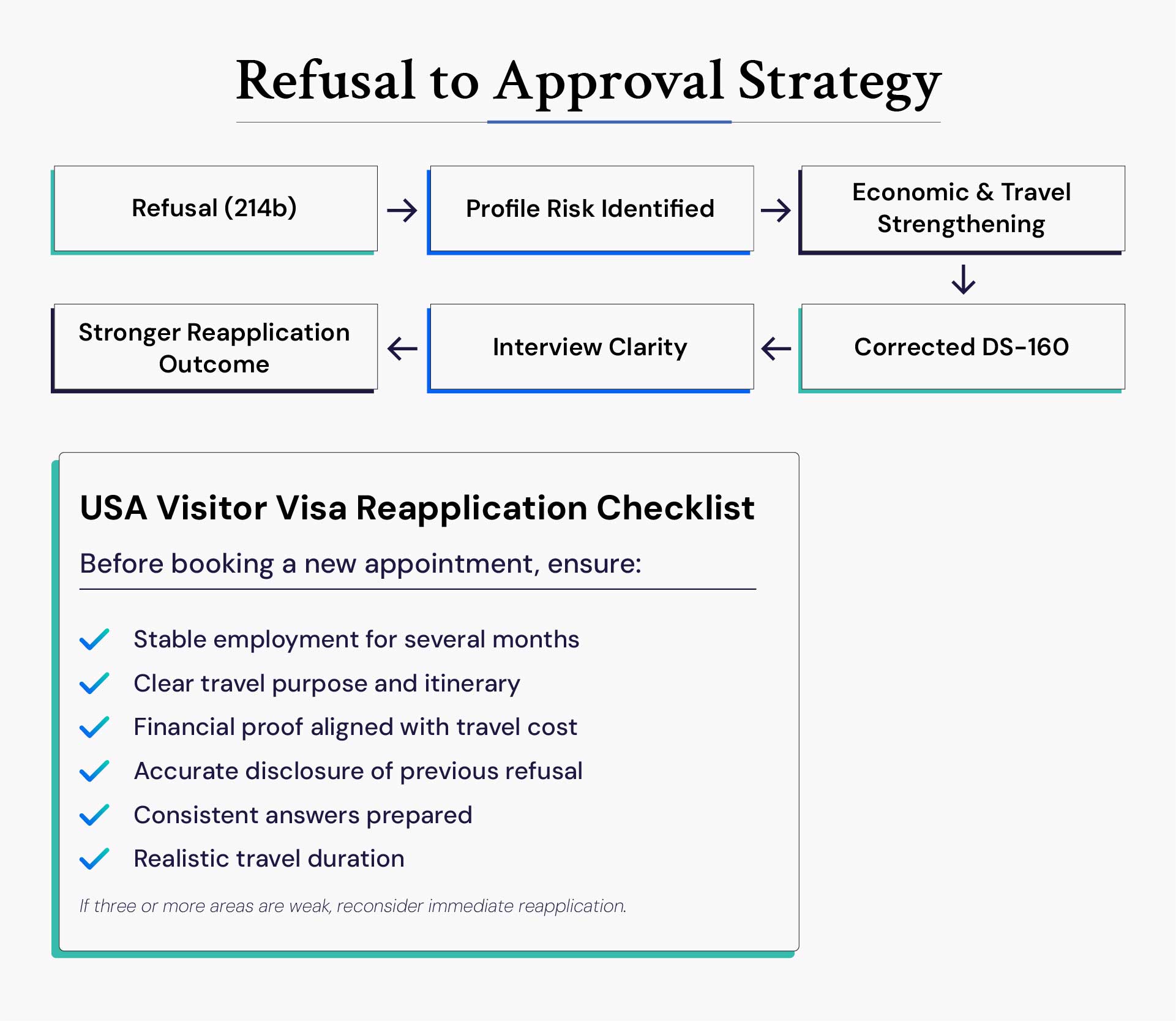
The B1/B2 visa is assessed on perceived immigration risk.
Officers evaluate:
The burden of proof lies on the applicant.
The objective is not to “convince emotionally” but to demonstrate stability logically.
Key Takeaways
Reapplying after a refusal requires structured risk evaluation and disciplined preparation.
Winny supports applicants by:
The objective is not to rush filing. It is to improve the probability of approval.
Yes. There is no mandatory waiting period after a refusal under Section 214(b). However, reapplying without any meaningful change in your profile often results in another refusal.
You should reapply only after strengthening factors such as employment stability, financial proof, travel history, or clarity of travel purpose.
A refusal under Section 214(b) means the consular officer was not convinced that you qualify as a temporary visitor.
It usually indicates insufficient proof of:
Yes, but not permanently.
All previous applications remain visible to consular officers. A prior refusal does not automatically lead to another rejection, but officers will compare your new application with your previous profile to see what has changed.
Demonstrating improvement is essential.
There is no fixed rule, but most applicants benefit from waiting until there is measurable change, such as:
Not necessarily.
Visitor visas are primarily assessed based on the applicant’s own ties to their home country, not the sponsor’s financial strength. Even with sponsorship, you must independently prove:
Only if your circumstances have genuinely changed.
Changing your travel reason without a logical explanation can create inconsistencies because officers can see past applications. Consistency and credibility are more important than changing strategies.
Yes.Ideally, your reapplication should reflect updated circumstances.
Examples include:
Travel history can strengthen credibility because it shows compliance with immigration rules. Travel to countries like the UK, Schengen Area, Canada, or Australia may help demonstrate responsible travel behaviour.
However, travel history alone does not guarantee approval if employment or financial ties remain weak.
Yes. There is no limit on the number of applications, but repeated refusals without profile improvement can negatively affect future assessments.
Each application should show clear progression or strengthened eligibility.
Common mistakes include:
Both matter, but the interview carries significant weight.
U.S. visitor visa decisions are largely based on:
Documents support your case, but the officer primarily evaluates your explanation and intent.
Yes. A U.S. refusal does not automatically affect visas for other countries. However, many visa applications ask about previous refusals, so you must disclose them honestly.
No. A large bank balance alone does not prove temporary intent.
Officers look for financial consistency and stability, including income source, employment continuity, and realistic travel affordability.


