
In 2026, Schengen visas are judged on overall credibility and risk, not just paperwork. Clear travel purpose, financial consistency, and strong return ties now decide approval.

Last updated for 2026 Schengen assessment patterns
In 2026, Schengen Visitor Visa rules and assessment practices have changed. Visa applications are no longer approved only by checking documents.
Today, visa officers review the entire applicant profile. This includes travel purpose, financial stability, job or business continuity, and the likelihood of returning to the home country. The process now focuses more on risk assessment than paperwork.
Even though travel from India to Europe is higher than ever, Schengen visitor visa rejection rates remain significant, particularly for first-time applicants.According to official data from the European Commission’s visa statistics, Indian citizens submitted over 1.1 million Schengen visa applications in 2024, making India one of the largest sources of short-stay visa requests to the Schengen Area. Of these, about 165,000 applications were refused, resulting in a roughly 15% rejection rate meaning about 1 in 6 Indian applications did not receive approval in 2024.
Many applicants are refused even after submitting all required documents. Refusal letters usually mention unclear travel purpose, weak proof of return, or financial concerns—often without detailed explanation.
This guide covers common Schengen visitor visa rejection reasons applicants should watch out for in 2026, how embassies evaluate applications today, and what improves approval chances—especially for applicants from India and higher-scrutiny regions such as Gujarat.
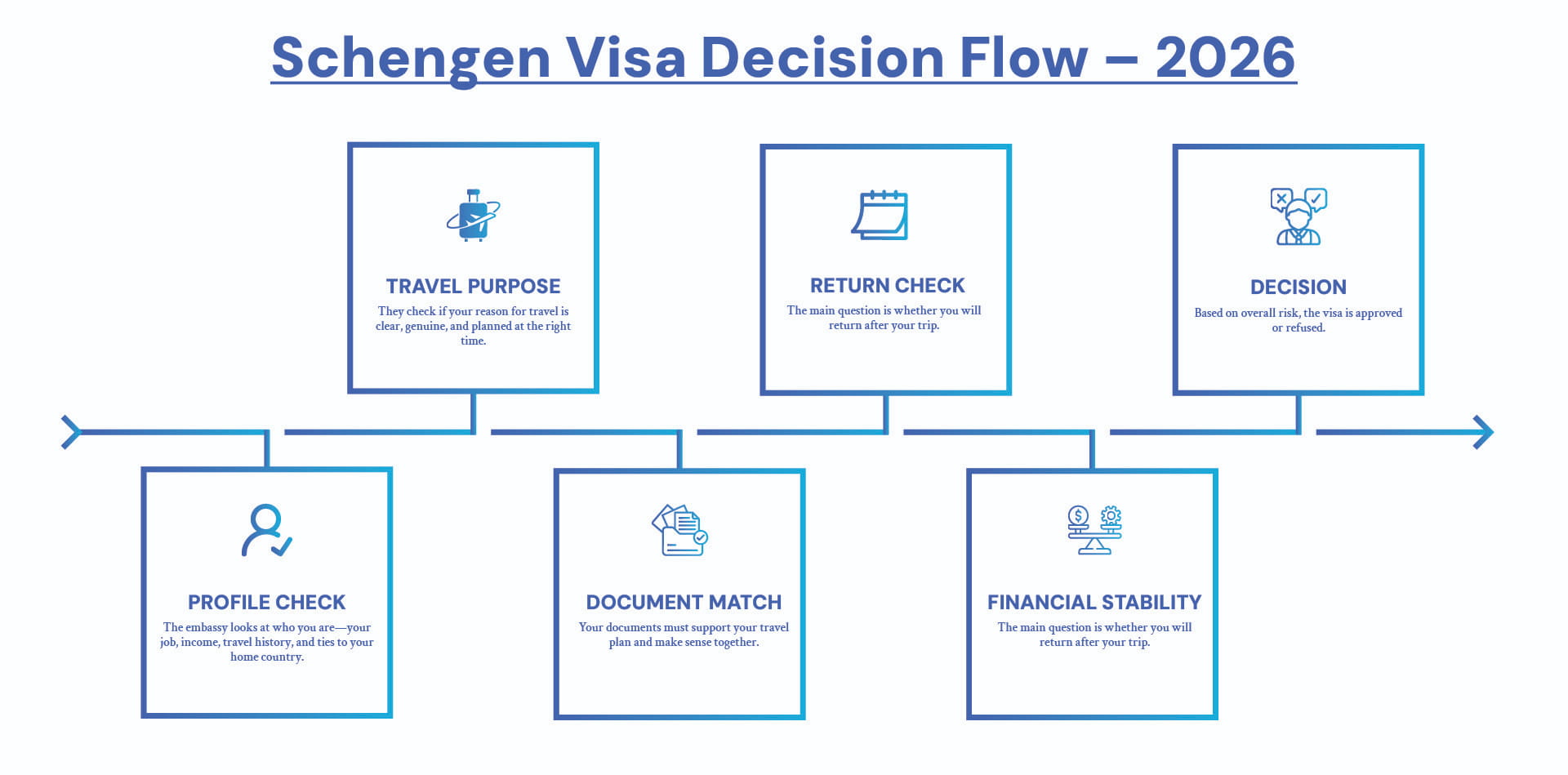
Earlier, Schengen visitor visa applications were assessed in a straightforward way. Applicants submitted the required documents, showed minimum funds, and provided valid travel insurance.
This approach has changed.
With the gradual implementation of the EU Entry/Exit System (EES) and stronger data sharing between Schengen consulates, visa applications are now reviewed more holistically. Authorities assess travel history, financial patterns, employment continuity, and document consistency as part of a broader risk-assessment process. In many cases, these checks begin digitally, even before the application is manually reviewed.
As a result, applications that meet basic document requirements can still be refused if the overall profile does not clearly demonstrate low risk and temporary travel intent.
Schengen visitor visas are document-led and compliance-based. Most embassies do not conduct interviews, which means applicants cannot clarify doubts verbally.
Decisions are made based on one core question:
Is there sufficient evidence that the applicant will leave the Schengen Area before the visa expires?
Each application is assessed independently. A previously approved Schengen visa does not guarantee future approval.
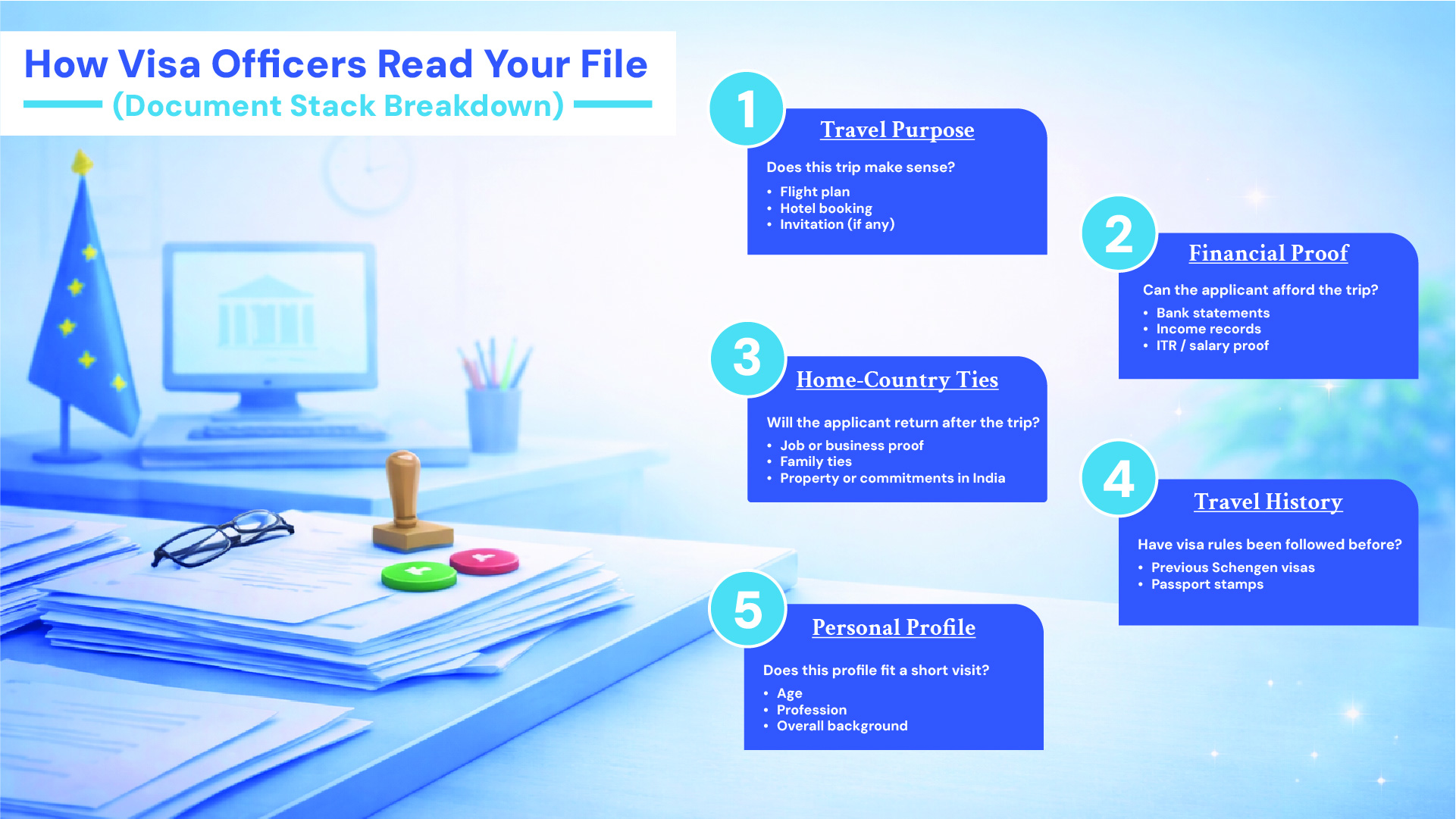
Below are the most frequent Schengen visitor visa rejection reasons, along with how applicants can reduce these risks.
Documentation errors remain the most common cause of Schengen visitor visa refusals.
Applications are frequently rejected due to unsigned forms, missing declarations, incorrect travel dates, or mismatches between itinerary details, accommodation bookings, and travel insurance.
A particularly common issue is incorrect embassy jurisdiction. Applicants must apply to the embassy of their main destination (longest stay) or first entry if stays are equal.
Applying elsewhere even for convenience is treated as non-compliance.
Schengen visas are not forgiving of technical mistakes.
Even small errors can weaken the entire application.
How to fix this:
Visa officers expect a clear and believable reason for travel.
Applications are often refused when the purpose sounds generic, copied, or disconnected from the applicant’s work profile or leave period.
Overpacked itineraries or unrealistic daily travel also raise doubts about genuine intent.
How to fix this:
Unclear return intent is one of the strongest reasons for Schengen visa rejection.
Even applicants with good finances and confirmed bookings may be refused if they cannot clearly show why they must return to India after the trip. While travel intent explains the reason for visiting Europe, return intent proves that the applicant has strong reasons such as work, business, family, or long-term commitments to come back before the visa expires.
How to fix this:
Embassies do not judge finances based only on final bank balance.
In 2026, officers focus on financial behaviour over time—income consistency, average balance, and alignment with declared occupation.
Sudden large deposits or unexplained credits often raise doubts.
How to fix this:
Travel insurance errors remain one of the most common technical reasonsfor Schengen visitor visa refusals.
Schengen rules require travel insurance to provide a minimum coverage of€30,000, be valid in all Schengen countries, include medical emergencies andrepatriation, and cover the entire travel period, including the day of arrivaland departure.
Applications are often refused when insurance dates do not exactly matchtravel dates, when coverage is limited to only one country, or when requiredclauses are missing. Even a one-day gap between insurance validity and traveldates can result in rejection.
How to fix this:
One of the most common questions applicants ask is whether a Schengen visitor visa approval can be guaranteed in 2026. The short answer is no.
Many applicants assume that certain factors automatically improve approval chances. In reality, these factors alone do not guarantee visa approval:
Schengen visa decisions are based on how well the entire application fits together. Visa officers assess overall profile consistency, credibility, and return intent not individual strengths in isolation.
Successful Schengen applications are built through structured storytelling, not document dumping.
Applicants must ensure that travel purpose, itinerary, finances, and return intent all support the same narrative. Embassy-specific requirements must be followed carefully, as Schengen rules are applied slightly differently by each country.
Generic templates and rushed submissions remain common causes of avoidable refusals.
A strong application consistently answers four questions across all documents:
Any contradiction between documents weakens credibility.
Schengen visas demand precision. Names, dates, passport details, travel timelines, and embassy jurisdiction must be verified carefully. Accuracy is not optional—it is foundational.
Strong applications include organised employment or business records, approved leave documentation, family proofs, financial continuity evidence, and long-term residence indicators where applicable.
These elements form the core foundation of Schengen visitor visa approval.
Applicants from Ahmedabad and across Gujarat often face deep-dive verification, particularly for self-employed or business profiles.
This includes stricter checks on GST registrations, ITR consistency, and document authenticity. Error tolerance is significantly lower.
Higher scrutiny does not mean inevitable rejection.
It means preparation must be materially stronger.
Key Takeaways
Winny Global follows a compliance-first, clarity-driven approach to Schengen visitor visas.
Support includes:
For individuals searching for a reliable visa consultant or immigration agency in Ahmedabad or Gujarat, the focus remains onresponsible guidance, long-term credibility, and realistic outcomes.


