
Prepare for your US B1/B2 visa interview with real questions, expert answer strategies, 214(b) refusal insights, and document guidance. A complete 2026 guide for Indian applicants.
A Complete, Evidence-Based Guide for Indian Applicants
The United States continues to be one of the most visited destinations for Indian travellers, including tourists, family visitors, business professionals, and medical travellers. According to the latest publicly available data from the U.S. Department of State, over 1 million B1/B2 visitor visas were issued to Indian nationals in FY 2023, making India one of the largest recipients of US visitor visas globally. Despite this high issuance volume, refusal rates under Section 214(b) remain significant, primarily due to failure to establish non-immigrant intent during the interview.
According to verified data from Winny Global,approximately 25–30% of US visitor visa applications face refusal, with the majority of refusals linked not to missing documents, but to failure to demonstrate non-immigrant intent during the interview. For Indian applicants, this makes interview preparation the single most decisive factor in visa outcomes.
In 2026, US consular interviews have become shorter, more standardised, and more intent-focused. Visa officers are trained to make credibility assessments within minutes, relying on clarity, consistency, and logic rather than paperwork volume.
This guide explains the actual logic behind US visitor visa interviews, outlines real interview questions and answer strategies, clarifies tourist visa USA requirements, and details what documents matter (and what do not). It is written for applicants who want to understand the process deeply, not rely on guesswork.
The B1/B2 visa is a non-immigrant visa, issued strictly for temporary visits.
It does not permit:
Visa officers are trained to detect non-immigrant intent. Regardless of how a question is framed, its underlying purpose is to assess whether the applicant genuinely intends to stay temporarily and return to India after the visit.
Contrary to popular belief, the US visitor visa interview is not document driven. Officers do not “verify files”; they evaluate people.
The single core question is:
Will this applicant leave the United States after the visit?
To answer this, officers assess five pillars:
A strong bank balance cannot compensate for weak intent. Likewise, a sponsor cannot replace personal ties.
US consular officers do not use a fixed script. However, most interview questions follow common patterns and fall into predictable categories. Each question is designed to test a specific risk factor under US immigration law, particularly non-immigrant intent under Section 214(b).
Understanding why a question is asked is more important than memorising answers. Applicants who understand the intent behind questions consistently perform better.
Below is a detailed breakdown of the most common US visitor visa interview questions, what officers are actually assessing, and how applicants should approach each one.
What the officer is assessing
This question establishes the foundation of the entire interview. Officers are testing:
In 2026, vague or generic answers are treated as high-risk signals, especially for first-time travellers.
What a strong answer demonstrates
Example of a strong answer
“I’m visiting the US for tourism for three weeks. I’ll be visiting New York and Washington DC.”
This answer works because it is:
Answers that weaken credibility
Key insight
Officers are not interested in how excited you are. They are interested in whether your visit is clearly temporary.
What the officer is evaluating
This question tests proportionality whether your intended stay makes sense given:
Long stays are not illegal, but they are scrutinised more closely, especially when employment or business ties appear weak.
What works best
Example
“Three weeks. I have approved leave from my employer.”
What raises concern
Key insight
Officers are assessing whether your life in India can realistically pause for the duration you claim.
This is one of the most important questions in the interview.
What the officer is checking
This question establishes your primary tie to India, which is central to non-immigrant intent. Officers assess:
What a strong answer includes
Example
“I’m a project manager at a manufacturing firm in Pune. I’ve been working there for six years.”
This answer works because it signals:
What to avoid
Key insight
This question often decides the interview. A weak or unclear response here is difficult to recover from.
What the officer is assessing
This question is not about affordability alone. Officers are checking:
What matters most
Example
“I’ll be funding the trip myself from my salary and savings.”
If sponsored:
What weakens credibility
Key insight
Officers trust consistent income more than large bank balances.
What the officer is assessing
This is a risk-mapping question, not a trick.
Officers are checking:
Critical rule
Always answer honestly.
Why honesty matters
Best approach
State:
Without defensiveness or over-justification.
Key insight
Hiding relatives is far more damaging than having them.
What the officer is evaluating
This question checks travel compliance history, not eligibility.
Prior international travel:
However:
Best approach
Answer factually and briefly.
Key insight
A clean profile with strong Indian ties can outweigh weak travel history.
What the officer is checking
This question tests timing logic. Officers want to know whether the trip fits naturally into your life.
Strong answers connect timing to:
Weak answers
Key insight
Timing that feels planned is trusted. Timing that feels impulsive is questioned.
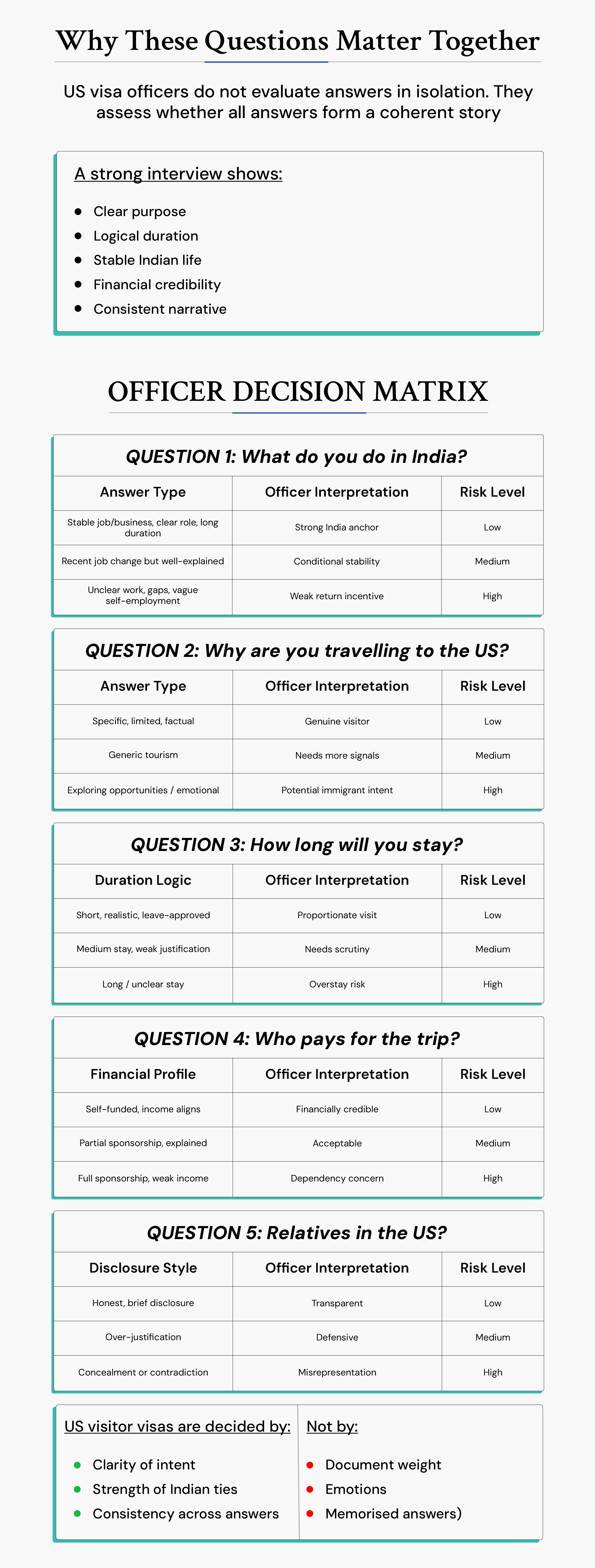
Applicants are expected to carry supporting documents, but it is critical to understand their actual role in a US visitor visa interview.
Unlike many other countries, the US visitor visa interview is not a document-verification exercise. Visa officers are trained to make decisions primarily based on answers, intent, and consistency, not on how many papers an applicant carries.
Most applicants bring the following documents as support, not proof:
In US interviews, answers establish credibility first. Documents onlyconfirm it.
The strongest applicants know what documents support their story, but rely on clear answers, not paperwork, to make their case.
Passing a US visitor visa interview is not about performance. It isabout credibility under pressure.
In 2026, US visa interviews are short, structured, and highlyintent-focused. Officers are trained to identify risk signals quickly.Applicants who understand this prepare very differently from those who rely onmemorised answers.
Best Practices That Consistently Work
Officers value precision. Answering beyond thequestion often introduces unnecessary risk or contradictions.
Clear, calm answers signal confidence andtruthfulness. Over-elaboration signals uncertainty.
Any mismatch—job title, income, travel purpose,duration can immediately weaken credibility.
The interview is not a test of confidence or Englishfluency. It is a test of clarity and intent.
Strong answers naturally reflect stability in India without having tojustify or exaggerate it.
Even strong profiles get refused due to avoidable communication errors.
Officers are trained to detect scripted responses. Natural clarity alwaysperforms better than rehearsed perfection.
Long explanations raise doubts, even when the intent is genuine.
Even casual references to opportunities, exposure, or extended stays cantrigger immigrant intent concerns.
The interview is not the place to convince or persuade. It is a place to becredible.
The strongest candidates sound prepared — not rehearsed.
The majority of US visitor visa refusals fall under Section 214(b) ofthe US Immigration and Nationality Act.
A refusal under 214(b) means the visa officer was not convinced theapplicant would return to India after the visit.
Most Common Reasons for 214(b)Refusals
An Important Reality Check
A 214(b) refusal is not permanent.
However, reapplying without addressing the original concern often results inrepeat refusals.
Whatchanges outcomes is better preparation, clearer intent, and stronger alignment,not time alone.
Winny’s approach to US visitor visa interviews is preparation-first andcredibility-driven, not template-based.
Applicants often approach us:
Our specialised interview-preparation team works evenin tight timelines, focusing on clarity, alignment, and confidence, notmemorisation.


